

In a recently published report, the Australian Competition & Consumer Commission (ACCC) warned that the country’s largest airports’ infrastructure investments could result in higher airfares, even if the airports are reporting record aeronautical revenues.

In a report that the ACCC published in early March, the Commission detailed that infrastructure investments at Australia’s four largest airports, namely Brisbane Airport (BNE), Melbourne Airport (MEL), Perth Airport (PER), and Sydney Airport (SYD), increased by 43% in FY2024/2025.
However, the ACCC warned that “consumers could face higher airfares as airports seek to recover their costs by charging airlines more in the coming years.”
“Airport charges will be higher than they should be if the airports undertake unnecessary investment, overspend in the delivery of the investment, and/or seek greater compensation for the risks involved than appropriate.”
According to the Commission, collectively, the four airports proposed spending almost AU$20 billion ($14.2 billion) to improve their infrastructure, including new terminals and/or runways at all four.
Still, Anna Brakey, the Commissioner of the ACCC, admitted that airports need to make those investments to “meet the needs of travellers and airlines.”
Brakey added that it is “important that airport charges reflect sensible and timely investment decisions, efficient costs and a rate of return that matches the risks involved,” with the Commission noting that airport charges are not regulated, and that it has “consistently raised concerns that the current monitoring framework is inadequate and an ineffective constraint on the behaviour of the major airports, who hold market power.”
Apart from SYD, which recorded a decrease in per-passenger aeronautical revenue YoY, the airports improved their per-passenger revenue, with MEL and PER posting double-digit growth. Individually, none of the airports reported double-digit growth in passenger numbers.
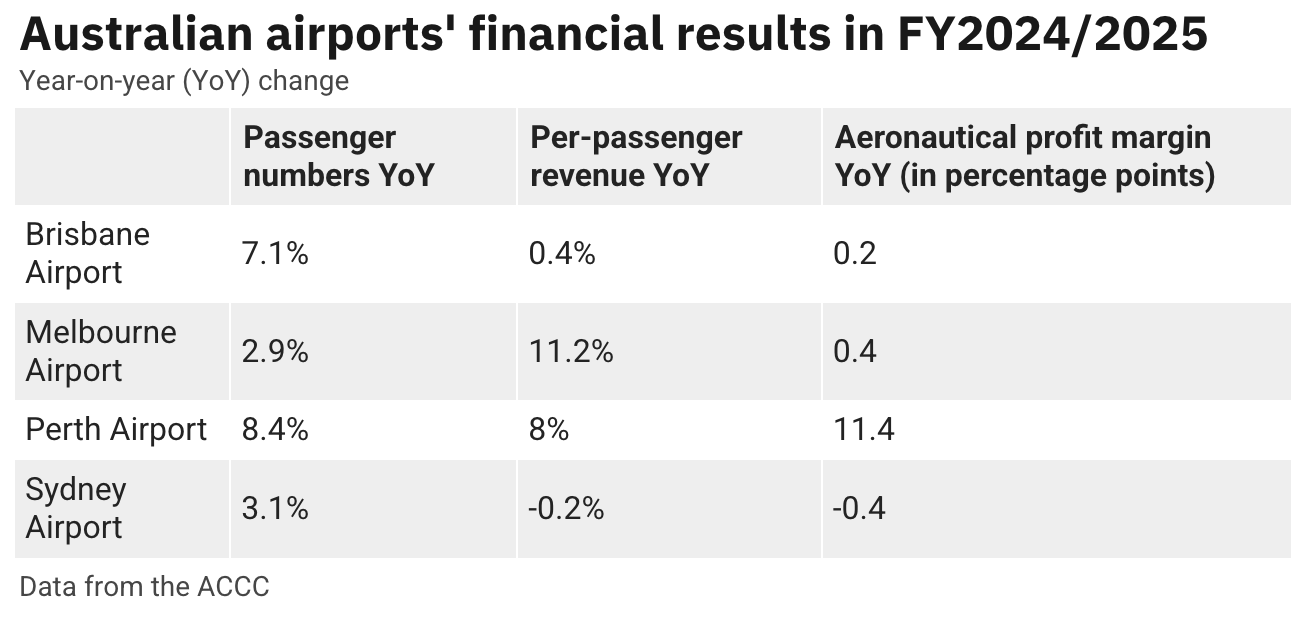
Brakey commented that SYD continues “to earn significantly more aeronautical revenue and profit than the other major airports, both from a total and per‑passenger perspective,” and that the airport’s aeronautical profits “eclipsed all of the other airports combined, more than double Melbourne as the next most profitable.”
In part, that is because SYD has a greater share of international passengers, and in part, it reflects the fact that the airport handles the most passengers in the country.
The quartet handled 120 million passengers in FY2024/2025, an improvement of 4.6% year-on-year (YoY). In FY2023/2024, passenger numbers grew by 13.7% YoY. International traffic growth slowed, according to Brakey, yet “the continued strong passenger growth reflects the willingness of international airlines to add services to Australia’s major airports.”
Domestic passenger numbers grew by 2.2% YoY, reflecting a “sustained demand for leisure travel and tourism within Australia.”
The ACCC concluded that various measures could be implemented to limit the airports’ market power. For example, establishing a “binding commercial arbitration to settle any disputes between airports and airlines, as well as improving the detail of financial data provided to the ACCC, would help to address the strong market power of major airports.”
This would potentially limit the growth of charges that are passed down to consumers.
 Rytis Beresnevicius