

An Aer Lingus Airbus A321XLR, which suffered a hard landing at Dublin Airport (DUB) in December 2025, is now back in service, returning to flying passengers after more than a two-month pause.

The A321XLR, registered as EI-XLT, returned to service on February 28, flying from DUB to Paris Charles de Gaulle Airport (CDG). That was the airframe’s first flight since December 13, 2025, when the aircraft was involved in a hard landing at DUB.
Neither Ireland’s Air Accident Investigation Unit (AAIU) nor France’s Bureau d'Enquêtes et d’Analyses (Bureau of Enquiry and Analysis for Civil Aviation Safety, BEA) has published a preliminary report about the event.
Since its return to service, EI-XLT has completed 29 flights, including 14 transatlantic crossings from and to Ireland, either DUB or Shannon Airport (SNN).
Aer Lingus took delivery of the aircraft on December 18, 2024, together with another A321XLR, registered as EI-XLR. Now, the Irish carrier has six A321XLRs in its fleet, with Airbus delivering the latest aircraft of the type on January 30.
Much like its A321LRs, the airline’s A321XLRs are configured with 16 business class and 168 economy class seats. From DUB, Aer Lingus’ longest A321LR/A321XLR routes in April include flights to Barbados Grantley Adams International Airport (BGI), Nashville International Airport (BNA), and Minneapolis-St. Paul International Airport (MSP), per Cirium’s Diio Mi.
The DUB-BGI flights are temporary services that replaced Aer Lingus’ flights from Manchester Airport (MAN) after the airline decided to close its base at the British airport in early January. The base will operate its last flight on March 30, flying to Orlando International Airport (MCO).
 Rytis Beresnevicius
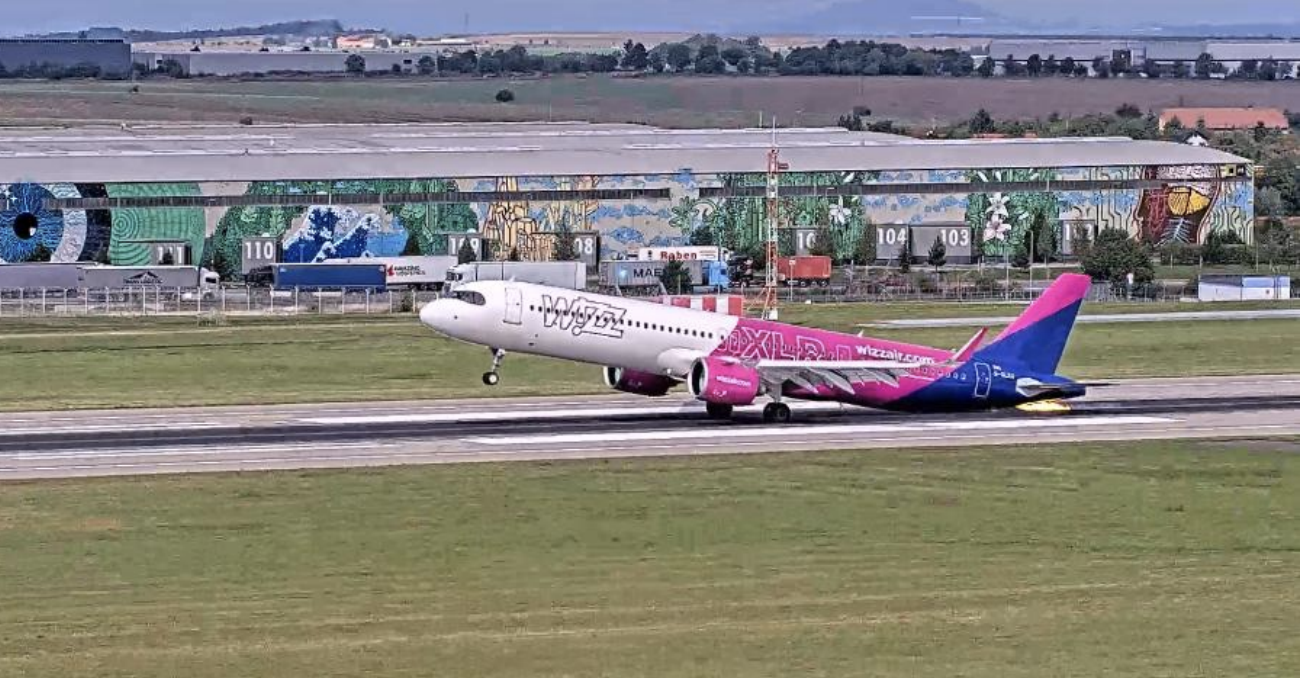
Nevertheless, another A321XLR has also been stored since being involved in an incident. The Wizz Air aircraft, registered as G-XLRA, has been at Prague Airport (PRG) since it suffered a tailstrike on September 11, 2025.
Later, the Czech Air Accidents Investigation Institute (Ústav pro odborné zjišťování příčin leteckých nehod, AAII) detailed that the aircraft reached a maximum pitch angle of 9.7° before its tail scraped along the runway during its landing at PRG.
The incident resulted in significant damage to the aft fuselage.
Rytis Beresnevicius