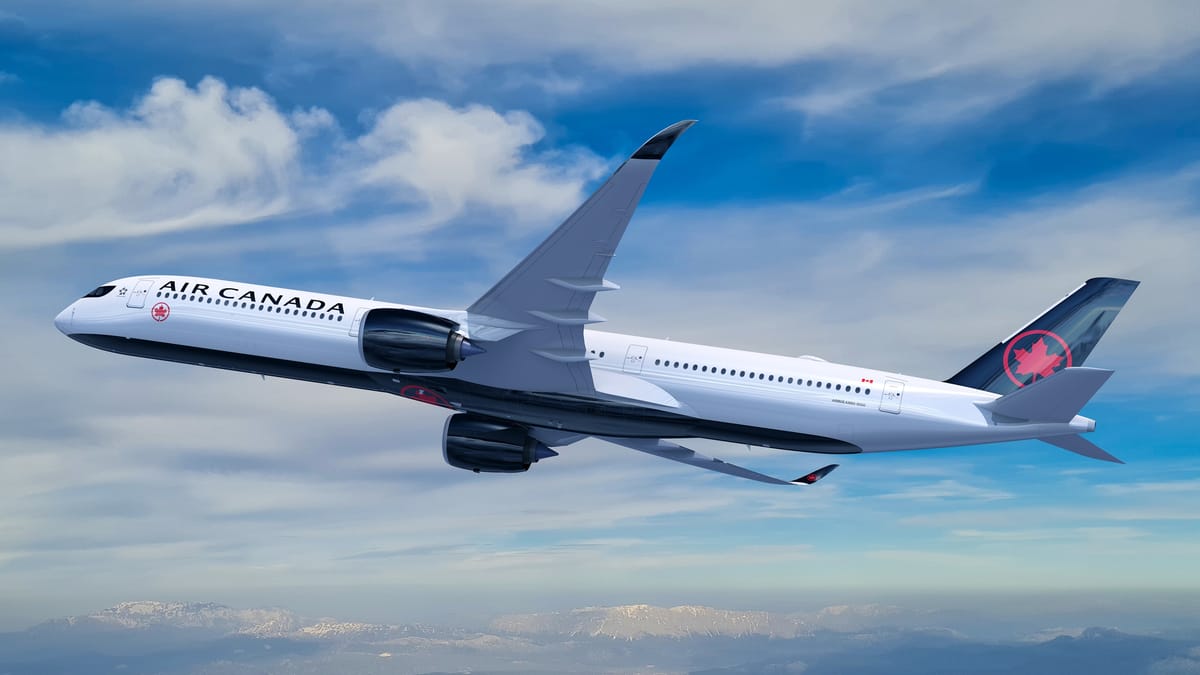


Air Canada, which had to navigate labor disruptions and significantly lower demand on transborder routes, ended the year on a strong note and, unlike in 2024, had a profitable last quarter.
The airline’s Q4 2025 net profit was CA$296 million ($217.4 million), while the full-year profit was CA$644 million ($473.1 million).

Plunging transborder revenues
As Canadians have become less willing to travel to the United States, the carrier’s revenues suffered a hit during the year.
Case in point: Air Canada’s full-year transborder revenues were CA$3.8 billion ($2.7 billion) in 2025, a 10.4% decline year-on-year (YoY). The only other market where revenues dropped was the carrier’s Pacific flights, suffering a 3.2% drop YoY.
The lower Pacific revenues reflected “lower load factors and yields versus 2024” and “normalizing yield environment following significant industry capacity growth in the Pacific market in 2024 and in 2025, as well as the impact of the labour disruption in August 2025,” Air Canada said.
Speaking about revenue developments on Canada-US routes, the airline highlighted that “reflecting a broad softening in demand beginning in the second quarter of 2025, compounded by the effects of the August labour disruption,” the market experienced a “notable decline,” it continued, blaming “ongoing concerns regarding tariffs and related geopolitical uncertainties.”
However, Air Canada’s transatlantic and other regions’ revenues did well in 2025: up 3.9% and 8% YoY, with the Canadian airline noting strong demand on flights to both. It classifies ‘other’ as Central and South America, the Caribbean, and Mexico.
Domestic revenue of CA$5.2 billion ($3.8 billion) was relatively flat, up 0.3% YoY. Total passenger revenue was CA$19.6 billion ($14.3 billion) in 2025, down 0.8% YoY.
Almost flat capacity growth
In 2025, Air Canada’s capacity, measured in available seat miles (ASMs), grew by only 0.8% YoY, largely due to the labor disruptions in August 2025, when the airline had to suspend operations completely between August 16 and August 19, 2025.
In contrast, Q4 2025 ASMs were up 3.4% YoY.
During the year and the quarter, Air Canada dispatched fewer seats while operating longer stage lengths.
The strong finish to the year was evident by the fact that in Q4 2025, total revenue per ASM (TRASM) was up 3.3%, while cost per ASM (CASM) was down 6.9% YoY. Full-year TRASM and CASM were the exact opposite: down 0.2% YoY and up 1.4%. YoY.
At the same time, the average yield was both lower in Q4 2025 (-0.6%) and in 2025 (-1.2%).
Returning to growth in 2026
With labor issues behind it, Air Canada is once again planning to increase its capacity in 2026. The airline’s guidance is ASM growth of 3.5% to 5.5%.
The guidance assumes modest economic growth in Canada, an average exchange rate of CA$1.36 to the US dollar, and an average fuel price of CA$0.90 ($0.66) per liter.
In 2026, Air Canada will add 35 new aircraft to its fleet, including its first 10 Airbus A321XLRs and a pair of Boeing 787-10s. Following the retirements of 16 A319ceo and five A320ceo, the airline will have 270 aircraft at the end of 2026, 14 more than at the end of 2025.
 Rytis Beresnevicius