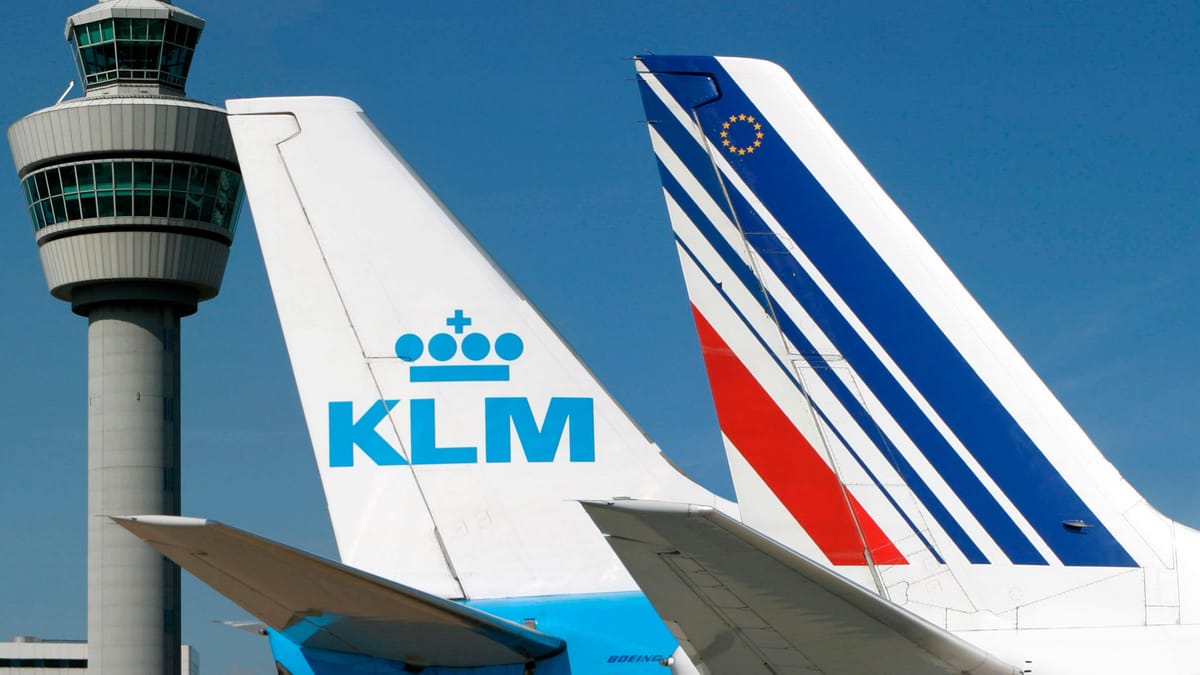


Executives of Air France-KLM, which significantly improved its full-year net profit despite a challenging demand and regulatory environment, have detailed how efforts to grow premium revenue have helped the airline navigate the turbulence in air travel in 2025.
Air France-KLM’s premium revenue efforts
During the Q4 2025 earnings call, Ben Smith, the Chief Executive Officer (CEO) of Air France-KLM, said that in 2025, the group “delivered strong execution, translating into positive results on multiple fronts,” including revenues reaching €33 billion ($38.9 billion).

Smith highlighted that Air France-KLM continues to redefine luxury travel and that during the year, Air France unveiled its new La Première experience, strengthened its in-flight entertainment (IFE) offering, and “simultaneously, both Air France and KLM continue to expand and enhance their high-speed Wi-Fi offering to meet growing customer expectations.”
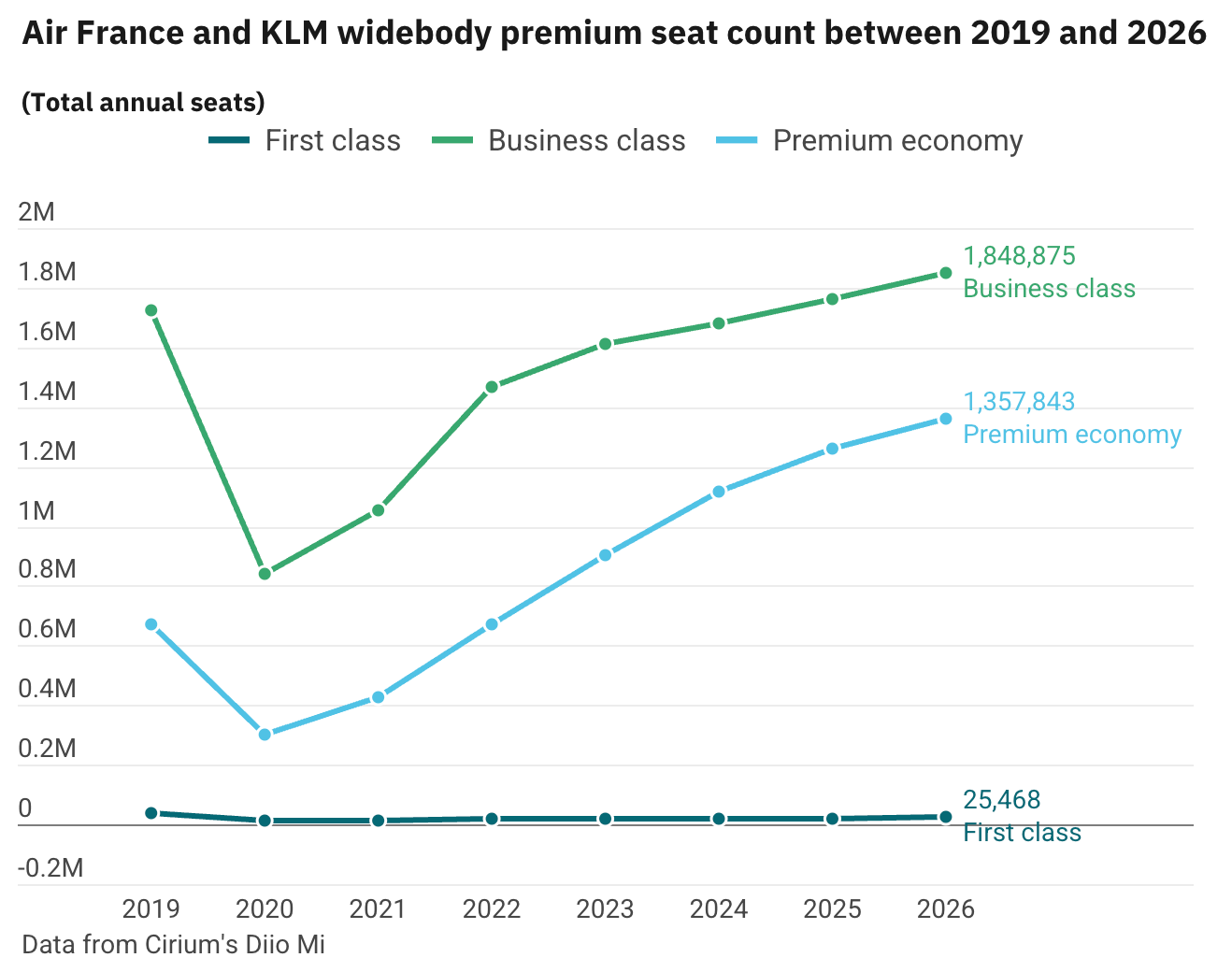
Cirium’s Diio Mi shows that in 2025, Air France and KLM’s premium seats, including first, business, and premium economy, continued to grow, with the Franco-Dutch group adding more premium seat capacity in 2026.
Smith also pointed out that Air France opened a new lounge at Chicago O’Hare International Airport (ORD) and refurbished its lounge at Boston Logan International Airport (BOS), “offering an elegant environment anchored in French hospitality.”
“Collectively, these initiatives demonstrate our unwavering commitment to strengthening the prestige and appeal of our brands at every touchpoint of the customer journey.”
Smith added that Air France’s La Première and Business and KLM’s Business Class accounted for 28.1% of the group’s total revenue, up from 26.9% in 2024, while premium economy offerings’ revenue “surged to reach 8% of revenue, showing significant growth over the last two years.”
In total, 36% of Air France-KLM’s revenue is generated by its premium cabins, including premium economy.
“This evolution is underpinned by strong commercial momentum. In 2025, La Première revenues grew by 17% and Business revenues by 9%. Our premium economy segments saw even more dynamic growth, with revenue up 18%.”
Smith concluded that the group’s shift toward “a higher value mix remains a key driver of profitability and long-term value creation.”
 Rytis Beresnevicius
Generating revenue in the United States
Meanwhile, Steven Zaat, the Chief Financial Officer (CFO) of Air France-KLM, continued that during the year, the group’s unit revenue was up 1% year-on-year (YoY), attributing it to its premiumization strategy.
Zaat detailed further that in the airlines’ first and business class cabins, “the load factor [was] up close to 1%, and the yields are up 4%.” Premium economy capacity growth was 8% YoY, and yields were up 6.8% YoY. The economy cabins saw a 1.4 percentage-point drop in load factors, the group’s CFO admitted.
Some of the challenges that Air France-KLM is facing include “the unique charges and taxation and airline focus in the Netherlands and in France,” as well as uncertainty about the Dutch government’s plans at Amsterdam Schiphol Airport (AMS), and whether annual flight movements will continue to be reduced at the Dutch airport.
In addition, demand for flights from Europe to the United States has seen some softness, according to both Smith and Zaat, with the group’s CEO saying that while it does see some softness, “it is being offset by [a] stronger point of sale [in the] US.”
Zaat explained that 56% of the airline’s transatlantic revenue came from point-of-sale in the US, which also carries a “significant” yield premium. The CFO added that US pricing has gone up.
In 2025, Air France-KLM earned €6.6 billion ($7.7 billion) of revenue from North America, Mexico, and French Polynesia traffic sales, up 6.2% YoY, with US point-of-sale comprising €4.4 billion ($5.1 billion) of that revenue, which includes maintenance-related activities.
The executive said that the Franco-Dutch group continues to be “surprised by the strong foothold of the point-of-sale” in the US, noting that it is a “very dynamic market.” While some are worried about a potential recession, the “prices are much different in Europe than over there.”
“All in all, I think, […] the booming on the North Atlantic is even exceeding our own expectations, and we still see very strong bookings coming in out of the US.”
 Rytis Beresnevicius