


Capital A, the parent company of AirAsia, and Bahrain’s Ministry of Transportation and Telecommunications (وزارة المواصلات والاتصالات) have signed a preliminary agreement for AirAsia to obtain an air operator’s certificate (AOC) in the country for direct flights from airports in Asia, as well as onward connections to Europe and the United States.
On November 3, 2025, Capital A and the Bahraini Bahrain’s Ministry of Transportation and Telecommunications signed a letter of intent (LoI) to potentially establish an AirAsia subsidiary in the country.
According to Tony Fernandes, the Chief Executive Officer (CEO) of Capital A, described the partnership as a game-changer, noting that with the end of the company’s airlines’ restructuring concluding soon, the company and its carriers are “are stepping into another bold and disruptive chapter of global growth, and Bahrain will be a powerful launchpad for us in the Middle East.”
“Bahrain continues AirAsia’s innovative and pioneering spirit of creating new models to carry on our mission of ‘Now Everyone Can Fly’, and this is reflected in the areas we are exploring with this partnership.”
Capital A detailed that the LoI stipulates that AirAsia will explore launching flights from Malaysia, Thailand, the Philippines, and Indonesia to Bahrain “with onward connectivity to Europe and the United States.”

In addition, AirAsia could obtain an AOC in the country, which will be used to establish a narrowbody-equipped airline to operate flights to “key cities in the Middle East, Central Asia, Africa and Europe.”
“By 2030, AirAsia expects to operate more than 25 daily flights via Bahrain, carrying over 20 million passengers over the next five years and contributing an estimated BHD 3 billion (USD 8 billion) to Bahrain’s economy.”
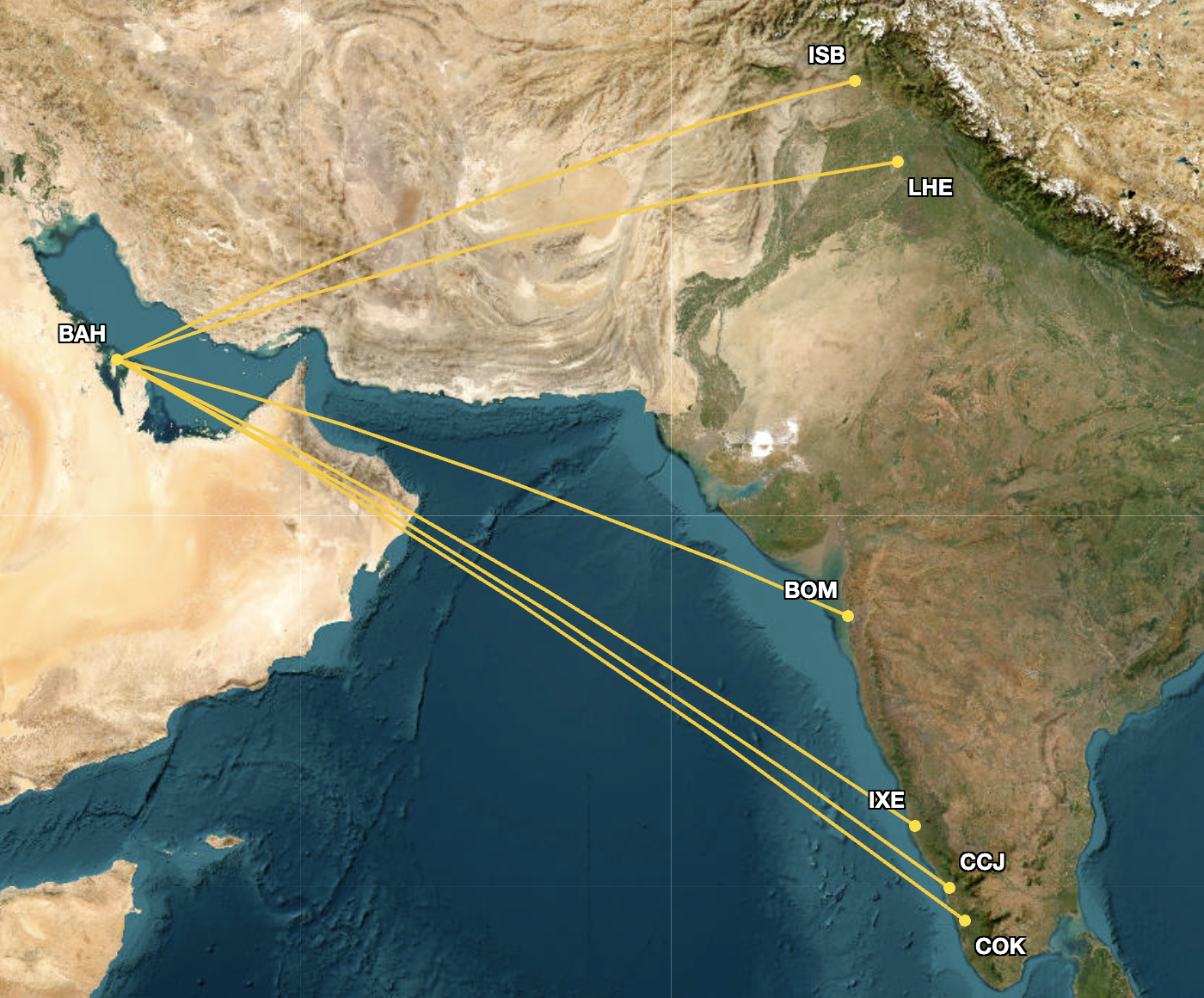
Per Cirium’s Diio Mi, low-cost carriers that have flights from/to Bahrain International Airport (BAH) in November include Air Arabia and its subsidiaries, Air India Express, flydubai, Fly Jinnah, flynas, Pegasus Airlines, and SunExpress. (Smartwings also operates flights from/to the airport.)
In Europe, the low-cost carriers only fly to Istanbul Sabiha Gökçen International Airport (SAW) and Trabzon Airport (TZX), as well as Bratislava Airport (BTS) and Prague Airport (PRG), if considering Smartwings’ scheduled departures from/to BAH.
From BAH to Asia, the low-cost carriers, namely Air India Express, Fly Jinnah, and IndiGo, only fly to six destinations, four in India and two in Pakistan in November.
AirAsia X, which had operated direct flights to Europe in the early 2010s, is also scheduled to return to Europe with twice-weekly flights to SAW starting on November 14.
Currently, AirAsia has eight active AOCs or brands with aircraft: AirAsia Cambodia, Malaysia-based AirAsia, AirAsia X, and Teleport (cargo-only, aircraft operated under AirAsia's AOC), Indonesia AirAsia, Philippines AirAsia, and Thailand-based Thai AirAsia and Thai AirAsia X.
In total, the airlines have 255 aircraft: 168 Airbus A320ceo, 40 A320neo, three A321 passenger-to-freighter (P2F) converted freighters, 15 A321neo, and 29 A330-300s, according to planespotters.net.
On October 30, Capital A announced that it had met all conditions to consolidate all AirAsia airlines under a single airline group, which will begin a new journey for the airline and the company.
The process should be completed by December and will allow Capital A to exit Practice Note 17 (PN17), which is issued by Bursa Malaysia, the stock exchange of Malaysia, that obliges listed companies to draw up a plan to lift themselves out of what Bursa Malaysia considers financial distress, to remain listed.
The announcement at the time detailed that once all of its airlines are consolidated under the AirAsia Group, it will be built around “key megahubs across the region rather than relying on a single home market." The goal, it said, is to improve “connectivity for guests, optimise aircraft utilisation, lower unit costs and create room for new growth with a focus on narrowbody planes.”
This includes the A321neo and A321XLR, Capital A said.


