

Amsterdam Schiphol Airport (AMS) has perhaps been the most extreme example of a government attempting to impose limits on the airport for the sake of residents living near it. However, a recent court ruling threw a spanner in the works, and the Dutch government is back to the drawing board on a new plan to limit flights at the airport.
All the while, airlines operating at AMS are seeking long-term clarity about their operations at the airport, whether they can plan to expand there or must look for alternatives as they open in another province.
Back to the drawing board
On March 11, 2026, the Supreme Court of the Netherlands (Hoge Raad der Nederlanden) ruled against the government’s decision, which was recommended by the Minister of Infrastructure and Water Management, to cap annual flight movements at AMS at 478,000, compared to the previous cap of 500,000.
The government’s decision also limited nightly movements to 27,000 between 23:00 and 7:00, down 5,000 from the previous limit.
According to the court, several stakeholders, including airlines and municipalities, appealed the decision, with airlines and their associations having considered “the limitation on the number of flights to and from Schiphol unacceptable.”
“In the opinion of the Administrative Jurisdiction Division, the Minister has not sufficiently substantiated his decision.”
The court added that per the Minister, who, at the time, was Barry Madlener, the flight limit would “serve as a limit for noise pollution.”
“However, that limit can vary, because a maximum number of flights does not fix the maximum noise pollution. By reasoning that the maximum number of flights can be considered a limit value for noise pollution in this case, the Minister disregards how the legislator intended that limit value, namely a maximum on the cumulative noise pollution of individual flights over a period of one year.”
The court noted that different aircraft produce different levels of noise, and as such, “a summation of flights alone provides insufficient information regarding the total amount of noise that may be produced in a year.”
While the court upheld the nightly movement limit, it mandated that the government draft a new, comprehensive amendment to the Airport Traffic Decree (Luchthavenverkeerbesluit, LVB).
In a statement on March 11, Royal Schiphol Group, which owns AMS, reiterated that all stakeholders “need clarity and certainty” regarding any limits at the airport.
“We are carefully studying the ruling and will enter into discussions with the Ministry of Infrastructure and Water Management [I&W] regarding what this means for the airport and the number of flights.”
Limits go up and down
Madlener was not the only Dutch I&W minister who had sought to reduce the number of movements at AMS. His predecessor, Mark Harbers, who led the Ministry between January 2022 and July 2024, sought to limit annual movements to 452,500 to reach the goal of reducing noise by up to 20% during the day and 15% during the night.
As the Dutch government changed hands, and Harbers was replaced by Madlener, I&W disclosed that, following input provided “by the sector during the summer,” the number of flights would be capped at between 475,000 and 485,000, according to a September 2024 statement.
Royal Schiphol Group did not wait around and took proactive measures, including, for example, introducing higher charges for noisier aircraft or for flights landing at night from 2025.
“For example, in 2027, an older A320 (category 3) will pay almost 3.5 times more than the quieter A320neo (category 7) during the day.”
In March 2025, the European Commission (EC) ruled that the I&W’s plan to cap flights at AMS at 478,000 per year had “some shortcomings,” including the fact that it only targeted commercial aviation, “exempting general aviation and business aviation from the measures, despite their contribution to noise.”
“The plan excludes the effect of fleet renewal, which the aviation industry will naturally proceed with based on current trends. The Netherlands did not provide sufficient evidence to support this approach or explain how it applies to Schiphol Airport specifically.”
Following the EC’s feedback, the I&W returned with a revised plan and, on May 7, 2025, introduced the changes to the LVB that were struck down by the Supreme Court of the Netherlands.
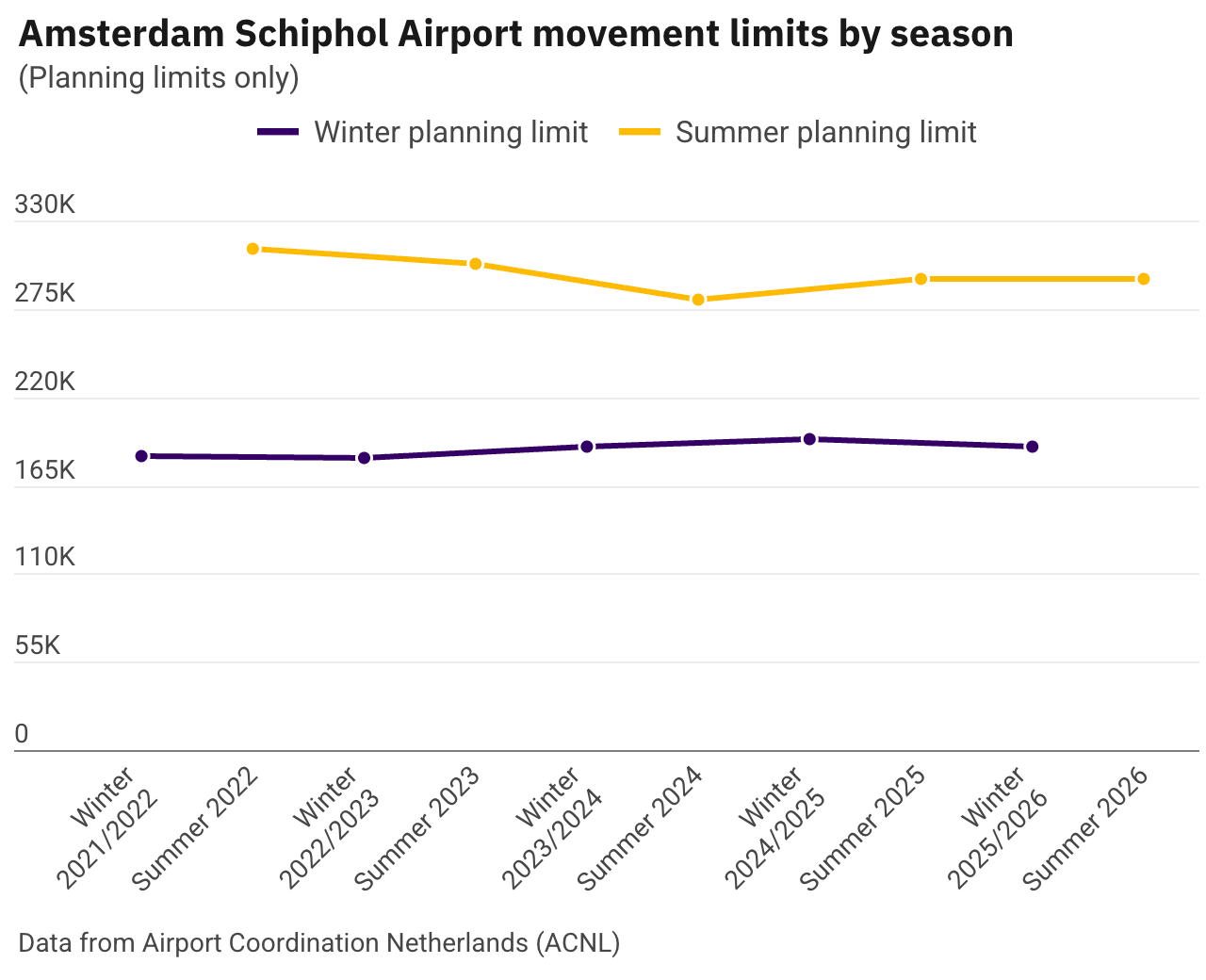
Throughout that time, the number of maximum planned flight movements at AMS varied by season. During the summer 2022 season, the cap was over 311,000; by the summer 2026 season, it had been reduced to over 293,000, according to seasonal reports by Airport Coordination Netherlands (ACNL), which coordinates slots at three Dutch airports.
Slot limitations at AMS had angered some airlines, including JetBlue. In a complaint before the Department of Transportation (DOT) in September 2023, Airlines for America (A4A), a United States-based airline lobby group that also represents JetBlue and other major US carriers, criticized the Dutch government’s plans to reduce movements at AMS.
The association alleged that the Dutch government had continued “to violate” European Union (EU) regulations and the US-EU Open Skies agreement “by unlawfully mandating capacity reductions” at AMS.
In a filing, A4A said that ACNL had plans “to retire slots that would otherwise be available to new entrants and withholding the assignment of certain slots to incumbents at the airport.” The association noted that, for example, JetBlue, which launched flights to AMS in August 2023, could lose access to the airport “because slots are allocated on a biannual seasonal basis, JetBlue will likely find itself in a unique situation of not being granted any slots for the next summer season, thus resulting in expulsion from the airport.”
A4A called for the DOT to consult with its European partners.
In November 2023, the DOT approved the A4A’s complaint, ordering Dutch carriers, including KLM, Martinair, the cargo arm of KLM, and TUI fly Netherlands, to file their US-bound schedules and any proposed routes and/or codesharing services in advance.
(If you are feeling deja vu, a similar complaint was filed against the Irish government regarding the passenger cap at Dublin Airport (DUB), which limits the annual passenger number to 32 million.)
 Rytis Beresnevicius
Seeking clarity
During Air France-KLM’s Q4 2025 earnings call with analysts in February, executives of the Franco-Dutch airline group were asked about the possibility of the opening of Lelystad Airport (LEY) to commercial flights.
Ben Smith, the Chief Executive Officer (CEO) of Air France-KLM, recalled that there had been plans to open the airport, “and there were discussions of even raising the cap at” AMS, which, at the time, was capped at 500,000 annual movements. The plans to grow the cap to 525,000 movements never materialized.
“Now we are sitting at a 478,000 cap movement at Schiphol. We would like that pretty much locked in stone, so we have some visibility,” Smith added, adding that Air France-KLM wants visibility on the number of movements and operating costs at AMS.
“I think once we have that, we will be able to, you know, take a position on Lelystad, whether it is good or bad.”
During the same call, Steven Zaat, the Chief Financial Officer (CFO) of Air France-KLM, was very open about the fact that charges at AMS shot up in 2025, adding that if anyone has not seen the results of Royal Schiphol Group, “they should be very happy with it” since the company had a margin of 26%.
“[…] unfortunately, it is on the back of our airline.”
According to Royal Schiphol Group’s annual 2025 report, LEY is scheduled to open for commercial aviation in 2027, “with a focus on leisure flights.”
While ACNL does not publish operator-specific slot allocations at its monitored airports, Cirium’s Diio Mi shows that in 2025, KLM and Transavia had 289,969 flight movements from/to AMS. Shifting some of Transavia’s leisure-focused movements to LEY could grant KLM some relief and allow the Dutch carrier to expand its operations at the slot-constrained airport.
Per Cirium’s Diio Mi, easyJet, Delta Air Lines, and Vueling had the most flight movements besides KLM and Transavia. While the two low-cost carriers could also explore a move to LEY, Delta Air Lines and other mainline airlines, whether from the US or elsewhere, would have to make some choices if the new LVB includes an even lower flight cap.
When the Dutch government introduced planned annual flight movement restrictions, ACNL warned carriers that if the airport’s capacity is below the number of historic slots assigned to operators, it will use a “holistic view in spreading mandatory schedule amendments across the air carriers involved.”
At the same time, in a roadmap for AMS that the I&W created in mid-2025, the Ministry outlined that if it achieves the target of reducing noise by 20% at the airport, AMS’ flight movement cap may once again be lifted to 500,000.
“After November 1, 2026, it will be clear whether the package of measures has achieved the noise target of 15% for the first phase. Based on the effects, the Cabinet will assess what is to be done to achieve the overall goal of 20% less aircraft noise.”
Back on the rollercoaster we go.
 Rytis Beresnevicius