


Belavia, the flag carrier of Belarus, has been officially removed from the United States Office of Foreign Assets Control (OFAC) sanctioned entity list, which will enable the Belarusian carrier to conduct transactions with US-based businesses, including Boeing.
On November 5, 2025, the Belarusian Telegraph Agency (Беларускае Тэлеграфнае Агенцтва, BelTA), the state-owned news agency, confirmed that Belavia was removed from OFAC’s Specially Designated Nationals and Blocked Persons (SDN) list, with the US also authorizing Belavia to conduct transactions related to three aircraft that are operated on behalf of the Belarusian government.
The trio is a Boeing Business Jet (BBJ) 737-800, registered as EW-001PA, a 767-300ER, registered as EW-001PB, and a Bombardier Challenger 850, registered as EW-301PJ.
However, OFAC’s website reported that the agency has only removed sanctions against the Challenger 850, without mentioning the BBJ 737-800 and 767-300ER.

In September, when John Coale, a representative of Donald Trump, the President of the US, visited Belarus and spoke with Aleksandr Lukashenko, the de facto dictator of Belarus, Coale promised that sanctions against Belavia would be lifted, a decision that was supported by Trump himself.
Later in October, Lukashenko complained that Belavia had still faced obstacles in its operations, since the airline still had “some stupid obligations” related to US sanctions. “We cannot always fly, repair, or buy everywhere,” Lukashenko said, adding that US officials had known about these hurdles, which would take time to eliminate.
 Rytis Beresnevicius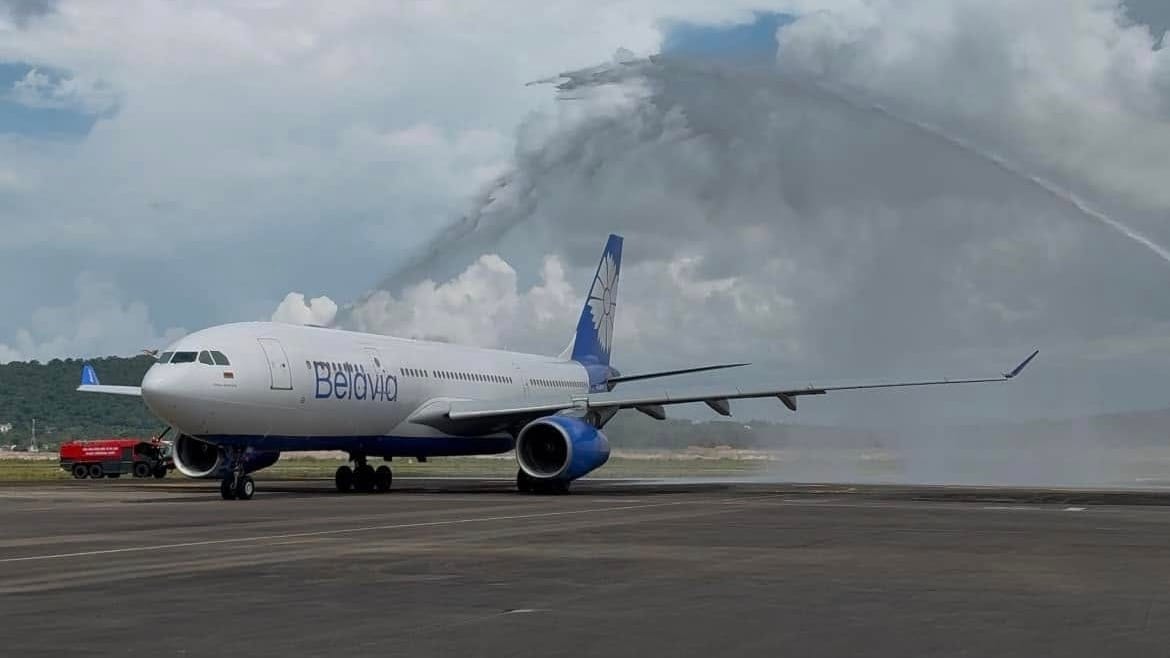
According to planespotters.net, Belavia has 16 aircraft in its fleet: three Airbus A330-200, which it acquired when it was still sanctioned, two 737-300, five 737-800, one 737 MAX 8, which Boeing delivered in April 2021, one Embraer E175, and four E195s.
When OFAC added Belavia to the SDN list in August 2023, Andrea Gacki, the former Director of OFAC, signed a document that outlined that all Belavia-related transactions, unless separately authorized, are prohibited. This included the airline and its directly or indirectly owned entities.
At the time, OFAC provided a wind-down period for any transactions involving Belavia until September 8, 2023, “provided that the goods, technology, or services that are provided, exported, or reexported are for use on aircraft operated solely for civil aviation purposes.”
In a press release in August 2023, the US Department of the Treasury, the parent agency of OFAC, said its action, which included other SDN list additions other than Belavia, targeted entities “involved in the Belarusian regime’s continued civil society repression, complicity in the Russian Federation’s unjustified war in Ukraine, and enrichment of repressive Belarusian regime leader Alyaksandr Lukashenka.”
“This action is taken alongside other recent actions of our partners and Allies, further highlighting the unified view that Belarus’s prolonged subjugation of its people and its continued support of Russia’s war against Ukraine remain a global concern.”
However, the war in Ukraine has continued, with Russia continuing to target civilians in its air attacks against Ukraine. In addition to supporting Russia, Belarus has also willfully ignored – or actively participated in – the launches of numerous contraband balloons across its border to Lithuania, which has resulted in flight disruptions due to airspace closures, especially in the past month.
According to the European Union’s (EU) consolidated sanction list, which was last updated on October 28, Belavia is still listed as a sanctioned entity. The EU added the Belarusian airline to its sanctions list on December 2, 2021, concluding that Belavia not only has benefited from tax exemptions, but its management “also told its employees not to protest against election irregularities and mass detentions in Belarus, in view of the fact that Belavia is a state-owned enterprise.”
“Belavia is therefore benefiting from and supporting the Lukashenka regime.”
It remains to be seen how – and even if – the US will stop Belavia from potentially importing spare parts and then moving them to Russia, which has also been sanctioned by the US for its invasion of Ukraine in February 2022.


