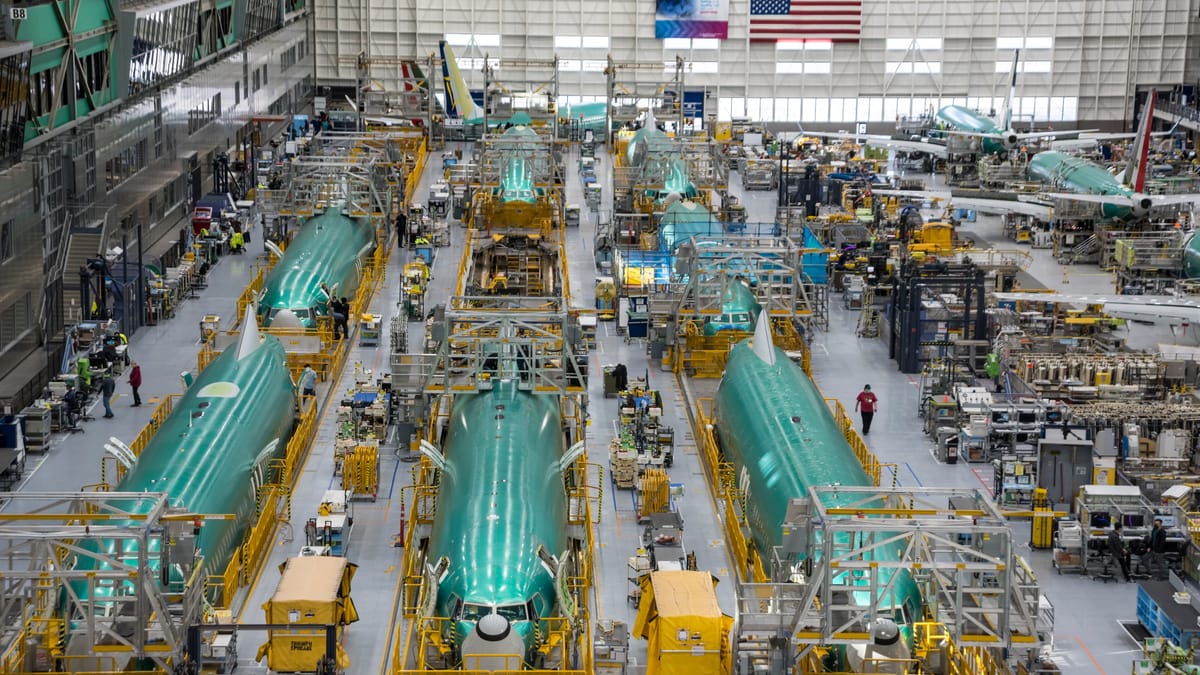


Airbus and Boeing have announced that they have completed the acquisition of Spirit AeroSystems’ sites related to the latter’s merger with Boeing, which was announced several months after the mid-air door plug blowout on an Alaska Airlines 737 MAX 9.
In statements on December 8, 2025, Airbus and Boeing confirmed that they have completed the acquisitions of Spirit AeroSystems’ assets. Florent Massou, the Executive Vice President of Operations at Airbus Commercial Aircraft, noted that this was a special moment for the planemaker, adding that it was proud to welcome over 4,000 new colleagues in a new chapter of its industrial operations.
Airbus has taken over six sites in Africa, Europe, and the United States. In Europe, the Saint-Nazaire, France, site, which produces A350 fuselage sections, will become Airbus Atlantic Cadréan, while the Belfast, Northern Ireland, site, where the A220’s wings and mid-fuselage are built, will become Airbus Belfast.
The Prestwick, Scotland, facility, where Spirit AeroSystems assembled wing components for the A320 and A350 family aircraft, will join Airbus’ supply chain as Prestwick Aerosystems, while the Wichita, Kansas, site, which built A220 family aircraft pylons, will be moved to Toulouse, France.
In Casablanca, Morocco, where Spirit AeroSystems used to build A220 and A321 components, Airbus will establish Airbus Atlantic Maroc Aero, while the Kinston, North Carolina, US, facility will become Airbus Aerosystems Kinston. There, the manufacturer will continue building A350 fuselage sections.

In relation to the divestitures, which were mandated by the European Commission (EC) and the Federal Trade Commission (FTC), Airbus received $439 million, “with the typical purchase price adjustments and subject to customary post-closing review.” The company will also receive “certain amounts to settle liabilities under the provisions of the purchase agreements.”
Meanwhile, Boeing celebrated the fact that the Wichita, Kansas, facility, and other sites that later became Spirit AeroSystems following its initial public offering (IPO), which it sold off in February 2005, will be reintegrated into its operations.
According to Kelly Ortberg, the President and Chief Executive Officer (CEO) of Boeing, the merger is a pivotal moment in the planemaker’s history and its future success, as it has begun to integrate Spirit AeroSystems' commercial and aftermarket operations, as well as to establish Spirit Defense.
The latter was mandated by the FTC, which stated that Spirit Defense “cannot discriminate in favor of Boeing in its dealings with other competing military aircraft companies and must protect those companies’ confidential information.”
Ortberg continued that the manufacturer’s focus will be “maintaining stability so we can continue delivering high-quality airplanes, differentiated services, and advanced defense capabilities for our customers and the industry.”
Boeing acquired all of Spirit AeroSystems’ operations related to itself, including fuselage production for the 737 MAX and major structures for the 767, 777, and 787. The merger also brought back Boeing’s largest supplier of spare parts in-house, expanded the planemaker’s maintenance, repair, and overhaul (MRO) services footprint worldwide, and added to its rotable, lease, and exchange portfolio.
Some of the overlapping operations will be carved out. For example, in Belfast, Northern Ireland, Boeing will establish an independent subsidiary called ‘Short Brothers, a Boeing Company.’
“Spirit AeroSystems' commercial and aftermarket operations in Wichita, Kansas; Dallas, Texas; and Tulsa, Oklahoma, as well as Spirit's Aerospace Innovation Center in Prestwick, Scotland, will begin to integrate into Boeing.”
Around 15,000 employees across the five sites will become a part of Boeing, the company said.
The FTC was the last regulatory hurdle that Boeing jumped over in order to (re)acquire Spirit AeroSystems. In its proposed order, the US competition authority outlined that in order to finalize the acquisition, the company will have to divest Airbus-related sites, Spirit AeroSystems’ Subang, Malaysia, facility to Composites Technology Research Malaysia (CTRM), and continue providing support to other defense contractors.
The commission also appointed ALCIS Advisers “to observe and report on [Boeing and Spirit AeroSystems’] compliance with their obligations.”
Boeing unveiled the transaction on July 1, 2024, valuing the all-stock transaction at $4.7 billion. With Spirit AeroSystems’ debt, the merger’s price went up to $8.3 billion.
The then-President and CEO of Boeing, David Calhoun, said that the company believed the merger was “in the best interest of the flying public, our airline customers, the employees of Spirit and Boeing, our shareholders and the country more broadly.”
“By reintegrating Spirit, we can fully align our commercial production systems, including our Safety and Quality Management Systems, and our workforce to the same priorities, incentives and outcomes – centered on safety and quality.”
 Rytis Beresnevicius