


In its latest proposals, the United Kingdom’s Civil Aviation Authority (CAA) has put forward per-passenger charges at London Heathrow Airport (LHR) to balance the airport’s capital expenditure (CapEx) needs and airlines’ desire to contain costs as the airport looks to expand by building its third runway.

On March 31, 2026, the CAA proposed its initial charges that would apply to each passenger departing LHR during the next price control period – H8 – running between January 2027 and December 2031, replacing the current charges set out in H7, which will expire at the end of December 2026.
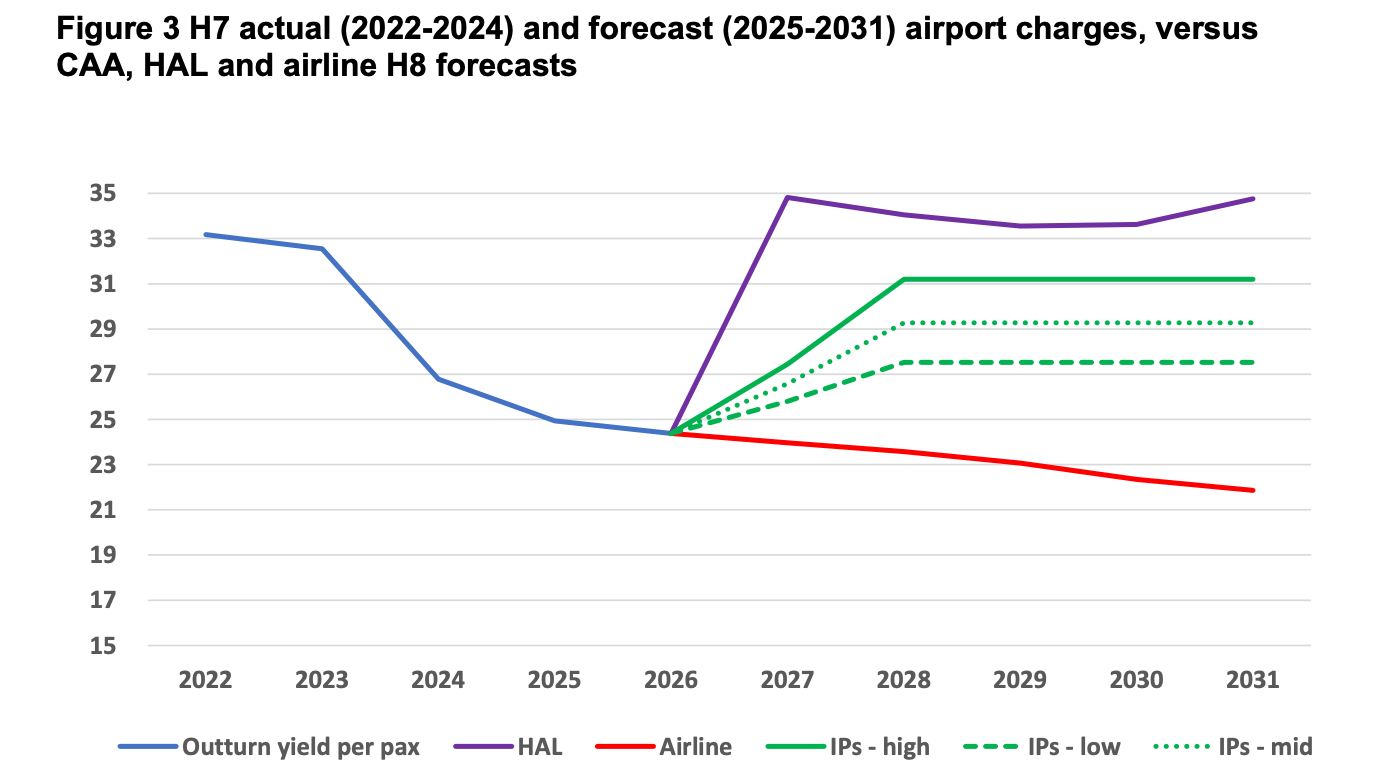
The UK’s aviation regulator pointed out that its proposed charges are essentially between the proposed charges by Heathrow Airport Limited (HAL), the company running LHR, and airlines that fly out of the airport.
“The mid-point of our range implies an average charge over H8 of £28.80 [$38] compared to average charges over H7 of £28.40 [$37.5]. Our mid-point is some 16% or £5.40 [$7.13] lower than HAL’s forecast and some 25% or £5.80 [$7.66] higher than airlines’ proposed approach.”
Selina Chadha, the Group Director of Consumer and Markets at the CAA, said that the regulator’s primary duty is to protect consumers, which is why the core of the initial proposal is its attempt to balance the well-being of passengers and support for LHR’s “sustainable growth, investment, and efficiency.”
“Our proposals for the airport charges levied by Heathrow on airlines strike the right balance between keeping passenger prices fair, while enabling the airport to make the investment needed to improve services for the future.”
The CAA will issue its final proposals in November 2026. The regulator pointed out that three factors influenced the level of charges in H8: passenger numbers recovering and going beyond pre-pandemic levels, the real costs of debt financing increasing, and “allowances for regulatory depreciation have risen in line with rising levels of capital expenditure.”
According to the CAA, as part of the H8 business plan, HAL submitted a CapEx plan of around £9.4 billion ($12.4 billion), around double the level of CapEx in H7. However, airlines “put forward an envelope of £5.4 billion [$7.1 billion] (2024 CPIH), raising concerns about insufficient detail, incomplete scoping and the deliverability of HAL’s much larger plan.”
As a result, the regulator removed CapEx projects associated with the ‘Modernising Heathrow’ program, as well as HAL’s proposal to “convert noise and vortex mitigations from opex to capex,” slashing the projected expenditures to £7.7 billion ($10.1 billion).
It then “scored HAL’s projects on the consumer benefit, impact, and likelihood of delivery for each project,” and with only “two-thirds of HAL’s proposed portfolio” having a strong need case, the CAA further cut CapEx to between £5.4 billion [$7.1 billion] and £6.1 billion [$8 billion].
HAL's initially published its expansion plan, which, according to Luis Gallego, the Chief Executive Officer (CEO) of International Airlines Group (IAG), was priced at £49 billion ($64.7 billion). The executive warned that if the plan is confirmed, “the passengers are going to pay double of what they are paying today.”
“So we have done our internal analysis of the maximum level of investment that we think, with the right phasing, we can afford in order to have flat charges for the passenger, and we have reached £30 billion [$39.6 billion] is our number,” Gallego said during IAG’s Q4 2025 earnings call on February 27.
“[…] what we are saying is if Heathrow is sure about what they are proposing and the extra passengers that we are going to have, and sure they do not have any problem to put a cap in the passenger charges, that at the end is to get that we have a cap in what they are going to pay and we don't increase what they are paying today that I think is enough, then we support any project.”
 Rytis Beresnevicius