


Full-year data for 2025 shows that capacity, measured in available seat kilometers (ASKs), and load factors from Canada to the United States have dropped as geopolitical tensions have resulted in Canadians choosing other options for their travels.
Department of Transportation (DOT) data, compiled by Cirium’s Diio Mi, shows that in 2025, ASKs from Canada to the US fell by 4.6% year-on-year (YoY), while the average load factor dropped by 3.5%, reflecting that Canadians have chosen to travel elsewhere due to the geopolitical tensions which flared up in early 2025.
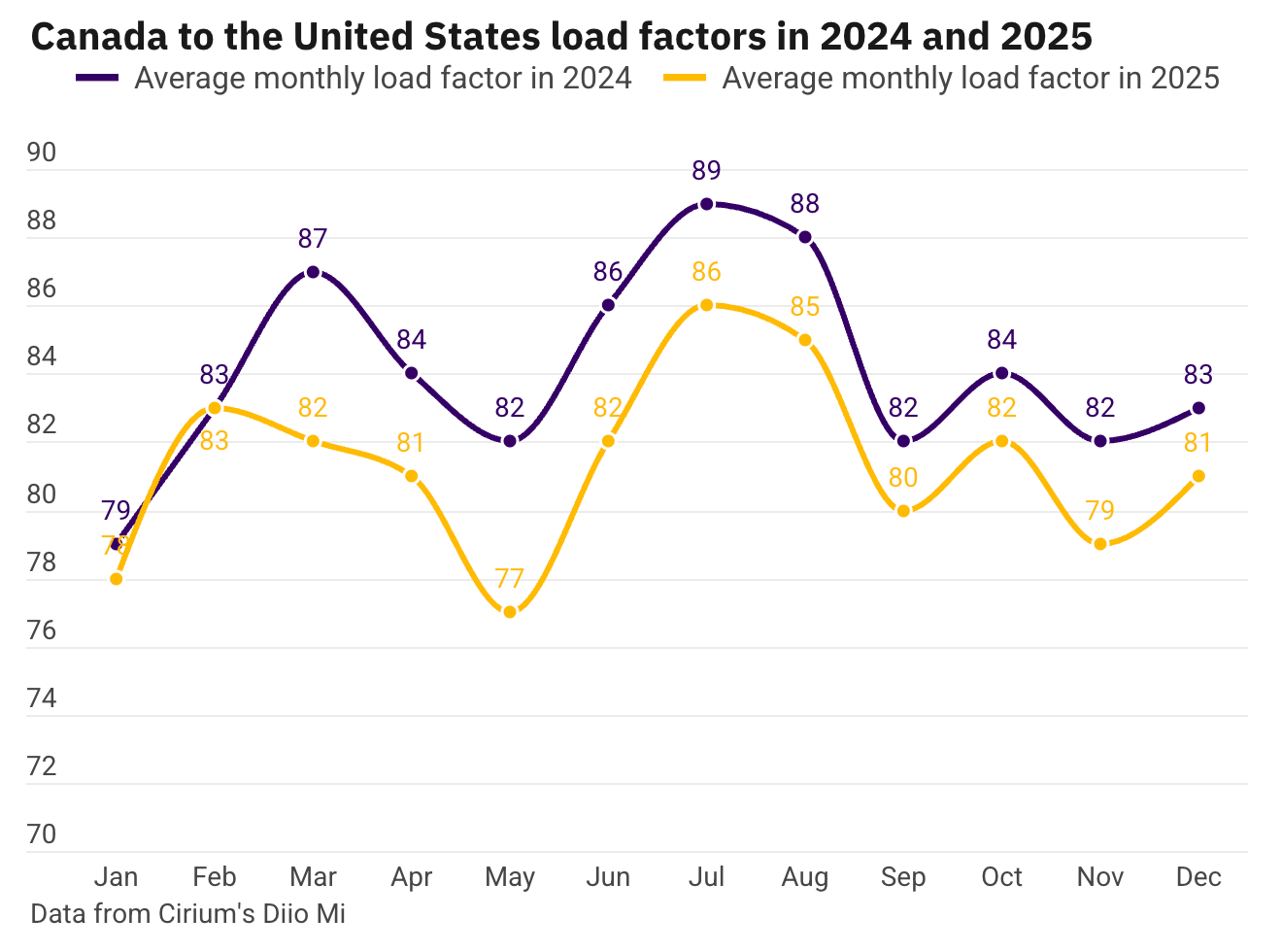
Load factors were down for both US and Canadian airlines. US-based airlines saw load factors fall by 3% on 6% lower capacity. Canada-based airlines saw 4% lower factors on 9% lower capacity.
Due to capacity shifts, US-based airlines’ ASK share in the Canadian-US market increased from 24% to 27%.
Instead, Canadian carriers, including Air Canada, Air Transat, Flair Airlines, Porter Airlines, and WestJet, have shifted capacity elsewhere, with their total international ASKs increasing by 5.3% YoY.
Air Canada, for example, said in its annual 2025 report, that while its passenger revenues had declined YoY, including due to the labor disruption in August and “lower transborder revenues,” international markets, like the Atlantic and Central and Latin America, “remained strong contributors, benefiting from robust leisure and visiting‑friends‑and‑relatives demand and effective deployment of long‑haul capacity.”
The Canadian carrier’s transborder passenger revenue per available seat mile (PRASM) declined by 0.8% YoY, while Atlantic passenger unit revenue was up 2.8% despite a 3.9% increase in capacity.
“During 2025, travel between Canada and the United States experienced a notable decline, primarily driven by ongoing concerns regarding tariffs and related geopolitical uncertainties. As a result of this reduced demand, Air Canada implemented capacity reductions in the transborder market.”
 Rytis Beresnevicius