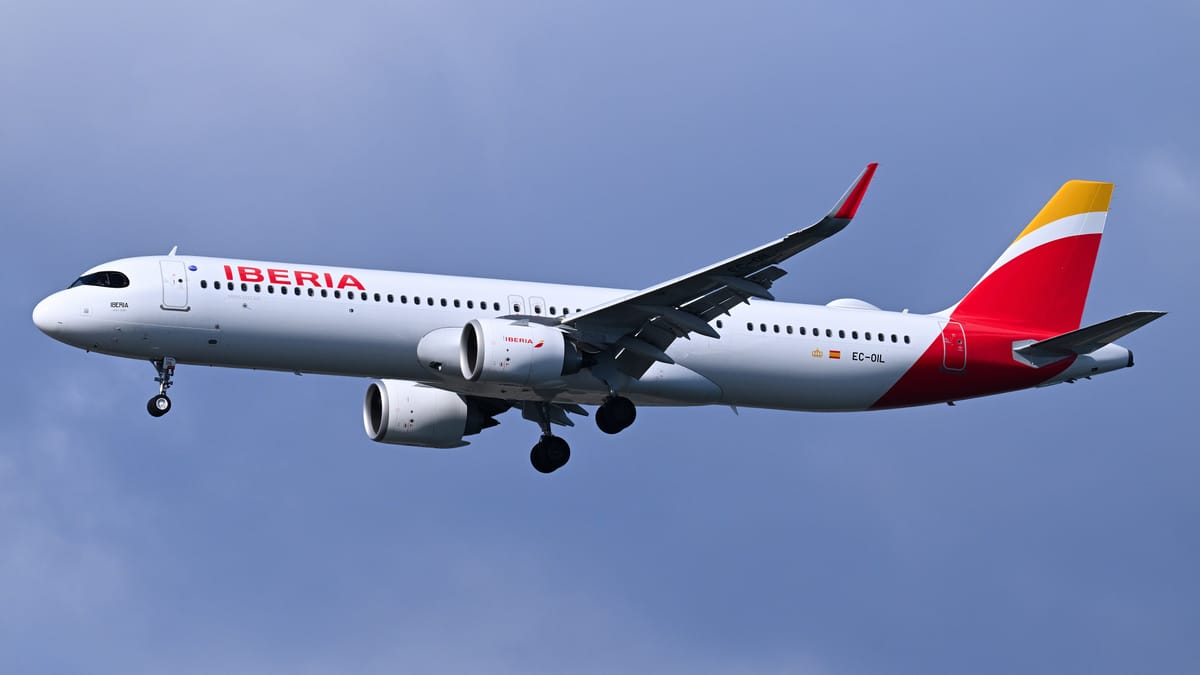


The Federal Aviation Administration (FAA) and the European Union Aviation Safety Agency (EASA) have released airworthiness directives (AD) that address portable breathing equipment (PBE) failures, which have happened on multiple occasions, including during a bird strike event involving an Iberia Airbus A321XLR in August.
On December 30, 2025, the FAA will publish an AD that will include additional requirements in addition to revised procedures for donning PBEs, which were included with a previous AD. The latter affected all aircraft equipped with Safran Aerosystems-manufactured PBEs, with the FAA warning that incorrect usage of the equipment “could lead to flight or cabin crewmember incapacitation, possibly affecting crewmember capability to accomplish tasks during an emergency, or resulting in fatal injury to that crewmember.”
Investigations had identified that the PBE operational manual “provides instructions that can be misunderstood by a flight or cabin crewmember, possibly leading to errors while donning the PBE.”
The previous AD mandated operators to adjust their procedures when donning PBE from Safran Aerosystems with specific part numbers (P/Ns). However, since that directive was issued, the United States regulator determined that “the unsafe condition may be addressed by incorporating updated procedures into documentation that [was] not identified” in the previous AD, with the procedures having now been revised.
“The PBEs are designed to protect the user’s eyes and respiratory tract in a contaminated atmosphere, which provides the ability to locate and combat a fire.”
The mandated procedure changes could affect around 80,000 PBEs installed on aircraft, including general aviation (GA) aircraft, registered in the US. Operators of affected airplanes will have 30 days after the effective date of the directive – January 14, 2026 – to amend the instructions for using PBEs.

However, EASA’s AD addressed PBEs that were “not delivering oxygen once donned,” warning that the condition could result in the “incapacitation of flight and/or cabin crew members, impair their ability to accomplish his/her tasks during an emergency, and could result in fatal injury to the affected flight/cabin crew member.”
To address the unsafe condition, Safran Aerosystems issued a service bulletin (SB) on December 19, with the European regulator publishing its AD on December 23. EASA’s directive has an effective date of January 6, 2026.
“Following investigation, a manufacturing issue has been identified, affecting certain PBEs manufactured between November 2015 and March 2017 (inclusive).”
Safran Aerosystems provided operators with a list of P/Ns of faulty PBEs, with EASA mandating their replacement within 14 days, which are installed in a cockpit or on aircraft having only a single PBE in the cabin, or within 3 months after the effective date of the AD.
The European regulator also introduced a life limit for the affected PBE, ordering carriers to remove the equipment from service 120 months after the manufacturing date of the equipment.
Following a bird strike in August, Iberia flight attendants struggled with their Safran Aerosystems PBEs and issues related to the equipment not delivering oxygen. According to a post-incident report by the Spanish Civil Aviation Accidents and Incidents Investigation Commission (Comisión de Investigación de Accidentes e Incidentes de Aviación Civil, CIAIAC), three out of four cabin crew members attempted to use PBE, yet were unsuccessful.
One failed to take out the equipment from its container, while another “suffered a cut on his finger while removing the equipment from its container and was assisted by his colleague in the rear galley […] to put it on.” While the PBE worked correctly, they took it off after thinking it was not.
Another flight attendant also cut their finger, and while they had donned the PBE, it “never delivered oxygen,” the CIAIAC pointed out. They lost consciousness, and another cabin crew member found them “unconscious on the floor with white lips, blue around the lips, red and swollen cheekbones and face, and not breathing,” successfully performing cardiopulmonary resuscitation (CPR) to restore breathing.
The bird strike happened on August 3, when the Iberia A321XLR, registered as EC-OOJ, struck a bird on departure from Madrid Barajas Airport (MAD). The aircraft returned to MAD following the incident and came back to commercial service only on December 27.
 Rytis Beresnevicius