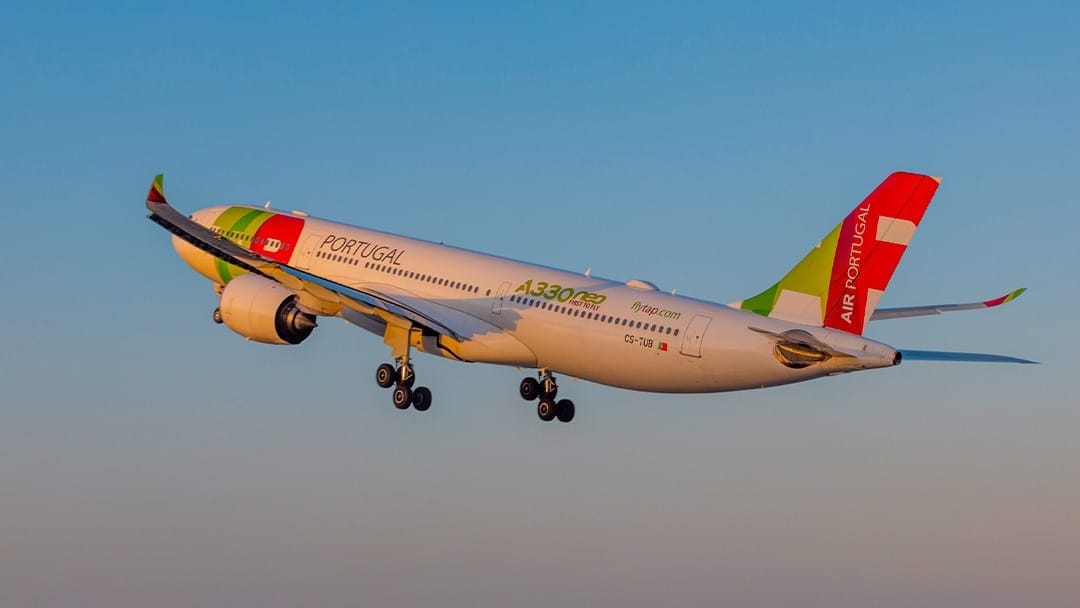


The European Commission (EC) has extended the deadline for SATA Group to divest a majority shareholding in Azores Airlines, and for TAP Air Portugal to sell off non-core businesses, which were part of the conditions for the EC to approve the Portuguese state aid granted to the companies in 2021 and 2022.
On January 5, 2026, the EC extended the deadline for SATA Group and TAP Air Portugal to complete their promised divestments, tied to the state aid the two companies had received from the Portuguese state in 2022 and 2021, respectively.
Now, SATA Group has until December 31 to comply with the EC’s conditions, with the Commission pointing out that “Portugal has offered to correspondingly reduce the aid amount and to prolong measures to ensure competition until the full divestment of the assets.”
The EC has mandated that SATA Group, the parent company of Azores Airlines, which operates the group’s flights from the Azores to mainland Europe, the United States, and other destinations, divest a majority shareholding of 51% of Azores Airlines, as well as “the carve-out and sale of its ground handling business unit.”
In June 2022, when the EC approved the Portuguese government’s €453.25 million ($530.8 million) state aid to SATA Group, which supported the company’s restructuring plan, in addition to the two conditions, the Commission noted that the restructuring plan included the establishment of a holding company, SATA Holding, and a ban from “any acquisitions and [...] a cap on its fleet until the end of the restructuring plan.”
When SATA Group announced its Q3 2025 results on December 5, 2025, the company said that the positive growth of its earnings before interest, taxes, depreciation, and amortization (EBITDA) during the first nine months of the year, as well as Q3 2025, showed the positive effects of its ‘Financial Sustainability Plan’ that has been active since mid-2024.
Rui Coutinho, the Chief Executive Officer (CEO) of SATA Group, added that the results showed that the Portuguese airline group was “on the right track to financially balance the company, with a clear focus on cost control, reversing the trend of cost increases exceeding revenue.”

Meanwhile, when the EC greenlit the state aid given to TAP Air Portugal, which amounted to €2.55 billion ($2.9 billion), and €107.1 million ($125.3 million) of aid to compensate for the pandemic-related losses, in December 2021, it said that its approval followed the review of the carrier’s restructuring plan.
The plan included the divestment “of non-core assets,” including subsidiaries in catering (Cateringpor), ground handling (SPdH, known as Groundforce Portugal), and maintenance (M&E Brasil).
“In addition, [TAP Air Portugal] will be banned from any acquisitions and will reduce its fleet until the end of the restructuring plan, streamlining its network and adjusting to the latest forecasts that estimate demand not picking up before 2023 because of the coronavirus pandemic.”
TAP Air Portugal was also forced to hand over “up to 18 daily slots to one actual or potential competitor” at Lisbon Airport (LIS), with the EC eventually ranking easyJet as the best suitor to take over the slots.
As the remedy taker, easyJet, which also received remedy slots at Milan Linate Airport (LIN) as part of Lufthansa Group’s acquisition of an initial shareholding of ITA Airways, launched new routes from LIS in October 2022, or at least was approved to do so from that date.
The EC extended the deadline for TAP Air Portugal to divest stakes in Cateringpor and SPdH until June 30.
On November 19, 2025, the Portuguese carrier stated that it ended Q3 2025 with a net profit of €126 million ($147.5 million). Luís Rodrigues, the CEO of TAP Air Portugal, admitted that while the airline had experienced one of the busiest summers, “it was also one of the most challenging” peak travel periods for the airline.
Still, Rodrigues added that despite the Portuguese government’s approval of the partial privatization of TAP Air Portugal, the carrier’s management will continue focusing on transforming it into a “sustainably profitable and attractive company.”
 Rytis Beresnevicius