


In a historic trade agreement signed today, the European Union (EU) and India, both affected by the trade policies of a single country, will strengthen economic and political ties, including lower tariffs on the EU’s exports to India, such as aircraft and spacecraft.
While countries within the EU have had direct connections with various cities in India, The Engine Cowl explores the current status of the EU-India air market and any potential market gaps based on the trade volumes between specific countries and India.
EU-India air market is growing in 2026
Cirium’s Diio Mi shows that in 2026, direct flights from the EU to India will increase by 12.4% year-on-year (YoY), with the number of scheduled departing seats growing by 12.2%. However, there will only be two brand new city-pairs in 2026 compared to 2025: Athens Airport (ATH) and Delhi Indira Gandhi International Airport (DEL), and Mumbai Chhatrapati Shivaji Maharaj International Airport (BOM).
Otherwise, the nine airlines flying between the EU and India, including new entrants like IndiGo – flights from BOM to Amsterdam Schiphol Airport (AMS) with Norse’s Boeing 787-9s began on July 2, 2025 – offer direct connections from 11 cities in the EU, including seven capitals.
The currently scheduled EU-India air network in 2026 is displayed below.
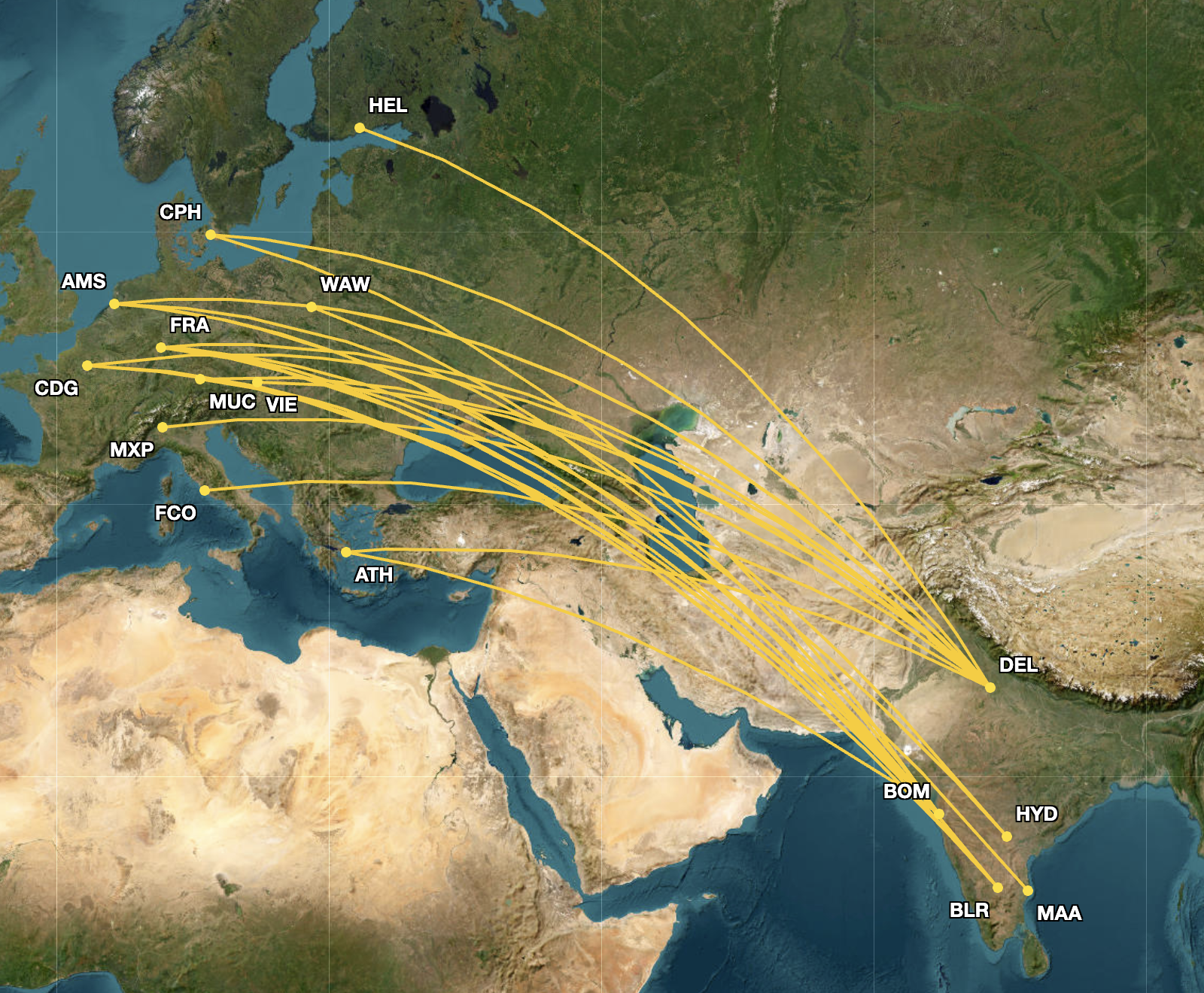
Neos has cancelled its two leisure-focused flights from Milan Malpensa Airport (MXP) and Rome Fiumicino Airport (FCO) to Amritsar Sri Guru Ram Dass Jee International Airport (ATQ), while LOT Polish Airlines will stop flying between Warsaw Chopin Airport (WAW) and BOM on March 24, according to Cirium’s Diio Mi.
While not brand new city-pairs, Air India will begin flying between FCO and DEL, currently also operated by ITA Airways. SAS is also set to enter the Copenhagen Airport (CPH) to BOM market, which IndiGo already serves with its leased 787-9s from Norse.
Remaining gaps
However, gaps remain. According to data from Eurostat, the official statistics portal of the EU, among the bloc’s top 10 goods exporters to India in 2024, namely Belgium, Czechia, Spain, and Sweden, still lack direct flights to India.
For example, Brussels Airport (BRU) last had a direct flight to India in 2018, when Brussels Airlines offered six weekly departures to BOM. According to The Brussels Times, in March 2025, BRU’s officials visited India, specifically Air India and IndiGo, in an attempt to lure the airlines to fly to the Belgian capital.
There is also no direct link between Madrid Barajas Airport (MAD) and India, with Air India being the last airline to fly the route in 2020. Stockholm Arlanda Airport (ARN) also lost its sole direct flight to India in 2020, while Prague Václav Havel Airport (PRG) has not had a non-stop itinerary to the Asian country since at least 2000, per Cirium’s Diio Mi.
Eurostat data showed that in 2024, Belgium, Czechia, Spain, and Sweden exported a combined €9.2 billion ($10.9 billion) of goods to India, while the EU’s combined exports totaled €48.8 billion ($57.9 billion) in goods sold to the country.
The EU also exported €26 billion ($30.8 billion) worth of services to India in 2023, with the top exporters of services to the country being Ireland, Germany, France, the Netherlands, Denmark, and Sweden.
Much like the five aforementioned capitals that lack direct flights to India, Dublin Airport (DUB) does not have a non-stop connection to any city in India.
In a statement to The Engine Cowl, John Strickland, an independent aviation consultant and founder of JLS Consulting, noted that India is set to become one of the largest economies in the world in the coming decades, ranking within the top three globally.
“European air services are a key economic enabler and a major opportunity for airlines. Add to this the large and growing Indian middle class, and we can expect to see airlines looking to add capacity.”


