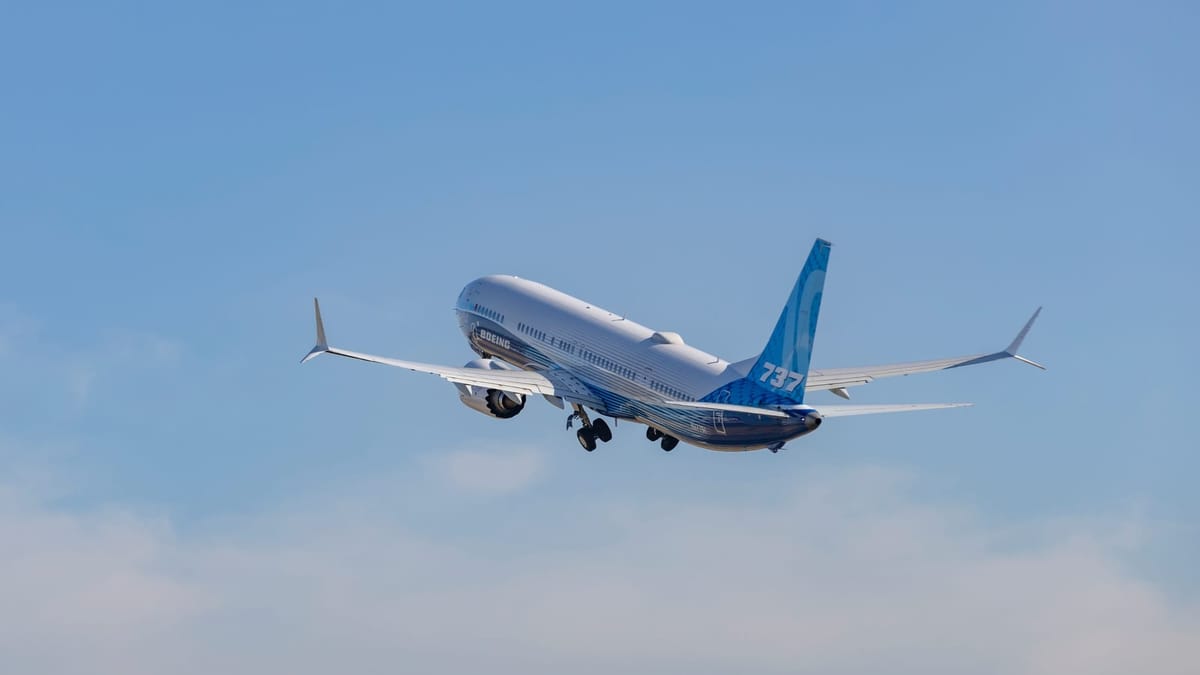


The Federal Aviation Administration (FAA) has outlined its plans to certify the Boeing 737 MAX 10, as well as fleet-wide changes that the regulator will mandate following the certification of the type, according to the amended United States Code (USC) regulations, which were implemented following the two fatal crashes of the type.
In a document that is scheduled to be published on December 15, 2025, the FAA presented its plan to implement and address requirements outlined in the Consolidated Appropriations Act of 2023, which mandates that any aircraft certified after December 27, 2022, have a modern flight crew alerting system.
The regulator pointed out that the rule, related to Flight Crew Alerting requirements, defined the considered models as the 737 MAX, including the 737 MAX 10. While the aircraft is yet to be certified, Boeing has proposed that the aircraft will incorporate a “synthetic enhanced angle of attack [AoA] system, and a means to shut off stall warning and overspeed alerts.”
A year after the certification of the 737 MAX 10, the USC will prohibit the FAA “from issuing an original airworthiness certificate for a Boeing 737 MAX aircraft, unless that aircraft’s type design includes safety enhancements.”
The enhancements include a synthetic AoA system and means to shut off stall warning and overspeed alerts, or their equivalents, the FAA said.

Three years after the type’s certification, the regulator will essentially ground any 737 MAX aircraft unless they are retrofitted with the aforementioned safety enhancements, “and the individual aircraft was produced or altered to be in conformance with that type design.”
The FAA’s implementation plan was split into four parts: evaluation and potential certification of the required safety enhancements for the 737 MAX 10, then for the whole 737 MAX aircraft family, monitoring Boeing’s progress of providing information to operators of the type, and ensuring that airlines fly retrofitted 737 MAXs before the three-year deadline.
The December 27, 2022, deadline, tied to the Aircraft Certification, Safety, and Accountability Act (ACSAA), was specifically carved out in the Consolidated Appropriations Act of 2023.
Maria Cantwell, a Democrat from Washington, and Roger Wicker, a Republican from Mississippi, introduced the ACSAA in June 2020. At the time, their joint statement read that the bill drew on the “lessons learned from the tragic Boeing 737 MAX crashes, making clear FAA’s oversight and authority over the aircraft certification process and including provisions to address human factors to accurately assess pilot response to cockpit alerts.”
Cantwell added that the legislation’s primary goals were to “make sure the FAA remains in the driver’s seat when it comes to certification,” making it clear that the regulator is in charge of the certification workforce and the approval process.
“Additionally, it requires the FAA to act on the NTSB’s [National Transportation Safety Board – ed. note] recommendations on new safety standards for automation and pilot training.”
The NTSB issued the recommendations in September 2019 as part of its role in investigating the two fatal 737 MAX 8 crashes in Indonesia and Ethiopia. The investigators said that while its investigation had been ongoing, “based on preliminary information, we are concerned that the accident pilot responses to the unintended MCAS [Maneuvering Characteristics Augmentation System – ed. note] operation were not consistent with the underlying assumptions about pilot recognition and response that Boeing used, based on FAA guidance, for flight control system functional hazard assessments, including for MCAS, as part of the 737 MAX design.”
As such, these recommendations should address pilots’ recognition and response to failure conditions that were part of the 737 MAX certification process, as well as changes to diagnostic tools to “improve the prioritization and clarity of failure indications presented to pilots.”
During the UBS Global Industrials and Transportation Conference on December 2, Jay Malave, the Chief Financial Officer (CFO) of Boeing, said that the planemaker was expecting the certification of the 737 MAX 10 “to be later in” 2026, with the company already planning to build 737 MAX 10s during the year, which could result in higher inventory numbers.
 Rytis Beresnevicius