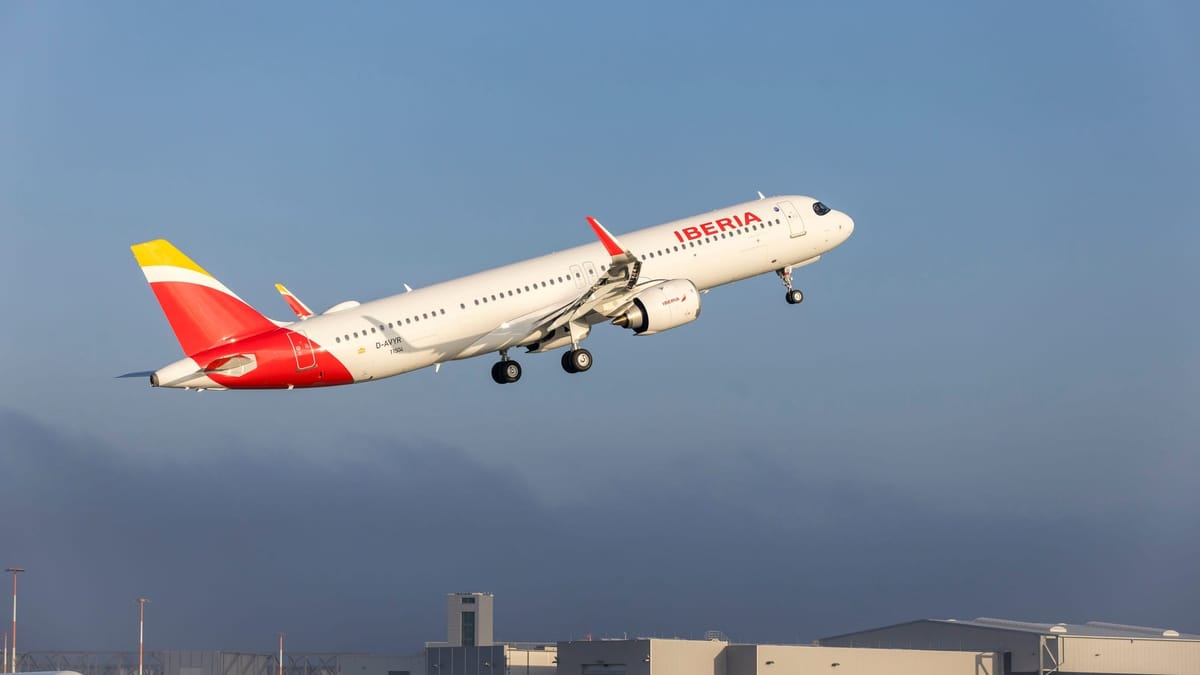


An Iberia Airbus A321XLR, which had been out of service following a bird strike that resulted in foreign object debris (FOD) entering the left-hand engine in August 2025, has now returned to service, including its first transatlantic flight since it came back to commercial flying.
On December 27, 2025, the Iberia A321XLR, registered as EC-OOJ, returned to commercial service, operating flight IB 529 from Madrid Barajas Airport (MAD) to Lisbon Airport (LIS), marking its first commercial flight in more than four months.
After returning to MAD on the same day, the A321XLR operated its first transatlantic flight on December 28, departing from MAD to Boston Logan International Airport (BOS). At the time of publishing, the aircraft landed at MAD on its return flight from BOS, touching down at the Spanish airport at 10:42 local time (UTC +1), according to Flightradar24.
It is scheduled to do another transatlantic run to BOS on December 29, departing the Spanish capital at 12:40, the flight tracking service showed.
Airbus delivered the A321XLR on June 30, according to planespotters.net.
The aircraft was taken out of service following an incident on August 3, when the A321XLR, operating flight IB 579 from MAD to Paris Orly Airport (ORY), encountered a “large bird,” according to the Spanish Civil Aviation Accidents and Incidents Investigation Commission (Comisión de Investigación de Accidentes e Incidentes de Aviación Civil, CIAIAC).

In its preliminary findings, the CIAIAC detailed that the bird strike happened at an altitude of around 6,400 feet (1,950 m). “The bird struck the nose of the aircraft, breaking off a large part of the radome, and debris from both the bird and the aircraft was ingested by the left engine,” the investigators added.
Following the FOD ingestion by the left-hand CFM International LEAP-1A engine, it shut down, “and the aircraft's interior filled with white smoke.” After declaring MAYDAY, the A321XLR returned to MAD, where it had stayed until its return to service.
Iberia Airbus A321-253NY (XLR) lands safely at Madrid Barajas Airport after a bird strike caused substantial damage to its nose cone. Flight IB579 to Paris Orly Airport returned approximately 20 minutes after departure from Madrid.
— FreSch (@fresch-dude.bsky.social) August 3, 2025 at 9:52 PM
[image or embed]
Its first post-incident flight was on December 26, when it operated a two-hour and 14-minute test flight over Spanish airspace before landing back at MAD.
While the CAIAIC initially said that nobody on board the A321XLR was injured, and that the airframe “sustained significant damage,” the Spanish investigators later detailed that three out of four cabin crew members had unsuccessfully attempted to put on Protective Breathing Equipment (PBE).
One flight attendant failed to “extract the equipment from its container,” while another “suffered a cut on his finger while removing the equipment from its container and was assisted by his colleague in the rear galley (TCP 4R) to put it on,” yet took it off after a few minutes since they thought it had not worked.
Another cabin crew member also suffered “a cut on his finger,” and while they put on the PBE, it “never delivered oxygen,” and they lost consciousness. Another flight attendant found them “unconscious on the floor with white lips, blue around the lips, red and swollen cheekbones and face, and not breathing,” and performed a successful Cardiopulmonary resuscitation (CPR).
A post-incident inspection of the PBE that never delivered oxygen showed “that the activation lever that must be actuated by the head when inserting it through the mask hole was broken, so that, although the hood was placed on the head in an apparently satisfactory manner, the activation lever never released the valve that supplies oxygen,” the CIAIC stated.
Following the incident, investigators tested out new PBEs at the manufacturer’s facilities, discovering a failure mode of the equipment, which “causes the aforementioned activation lever to break when trying to open the collar neck seal with the thumbs and then put on the hood.”
“When both thumbs are not inserted into the gap in the collar seal against its edge, but rather the left thumb is placed more towards the center of the opening and inside the hood, when pulling with both thumbs to open the hood, the left thumb also pulls on the activation lever in a direction in which it cannot turn and breaks.”
The CIAIC warned that PBEs from the same manufacturer with the same part number (P/N) are present on “many other aircraft,” presenting a similar risk of activation levers breaking when the flight crews are putting the PBEs on their faces.
While the investigation is ongoing, the CIAIC issued seven recommendations to the European Union Aviation Safety Agency (EASA), Iberia, and Safran Aerosystems, the manufacturer of the PBE.
The Spanish investigators suggested to EASA that it should recommend “to take appropriate measures to ensure that” Safran Aerosystems’ PBE would be “designed in such a way that it can be donned by crew members using a procedure that excludes inadvertent manipulation of critical parts of the PBE,” and that the equipment has a user manual that would minimize “the risk of crew members putting it on without inadvertent tampering with critical parts of the PBE.”
Safran Aerosystems should design the PBE that would prevent “inadvertent manipulation of critical parts” of the equipment, and ensure that the PBE has “a user manual that minimizes the risk of crew members putting it on without inadvertent tampering with critical parts of the PBE.”
EASA and Safran Aerosystems should also ensure that the manual is distributed to all airlines that have the PBE with the specific P/N installed on their aircraft.
Lastly, Iberia should make sure that its flight crews receive training related to the use of the PBE that is as “realistic as possible and alert them to the risks of not adhering to the established procedure for use.”
This is not the first time that a CFM International LEAP-powered aircraft has been involved in a bird strike, followed by white smoke filling the cabin. In 2024, after two separate bird strikes involving Southwest Airlines Boeing 737 MAX 8s in 2023, powered by CFM International LEAP-1B engines, the Federal Aviation Administration (FAA) initially rejected any potential changes to the LEAP-1Bs, despite safety concerns related to the engine’s load reduction device (LRD).
The LRD “is a mechanical device that fuses to reduce the loads transmitted to the engine structure and the aeroplane during high fan unbalance events,” according to EASA, which noted that flight crews have no control over whether the LRD activates.
“When the LRD is triggered (based on specific load thresholds), an oil leakage path is created, which allows leakage of both oil from the sump and oil from the oil supply tubes into the primary flow path.”
On June 18, 2025, the National Transportation Safety Board (NTSB), which had investigated one of the bird strike events involving the 737 MAX 8s, issued six recommendations to Boeing, CFM International, EASA, and the FAA. One of those recommendations was classified as ‘urgent,’ with the NTSB urging the FAA to ensure that flight crews, which fly 737 MAX aircraft, are aware “of the circumstances” of the incident involving one of the Southwest Airlines 737 MAX 8s.
Pilots should be aware of “Boeing’s changes to the quick reference handbook [QRH] and flight crew operations manual [FCOM], so pilots are aware of actions to take if they encounter smoke in the cockpit or cabin after load reduction device activation.”
In July, EASA issued a safety information bulletin (SIB) for CFM International LEAP engine family-powered 737 MAX and A320neo family aircraft operators, informing them that on 737 MAXs, pilots can refer to the QRH to “isolate the affected engine, which will mitigate the smoke contamination.”
A320neo family aircraft pilots, who fly LEAP-1A-powered jets, can also use the QRH to “secure the affected engine and mitigate the smoke contamination following LRD activation.”
“This SIB is an interim measure, pending completion of safety assessments and availability of potential design changes which might be required for managing the oil leakage risks for engine damage leading to LRD activation.”
EASA issued three recommendations, advising operators to provide information to their pilots about which aircraft in their fleet have LRDs, that the flight crews should be ready for LRD activation following “severe engine damage or engine high vibrations,” and that the device’s activation should be “properly emphasised during flight crew conversion and recurrent training,” which includes the consequences and mitigating actions of potential LRD activation.
 Rytis Beresnevicius