


On April 16, Lufthansa announced a series of decisive moves:
- Lufthansa CityLine will cease operation effective April 18 2026
- Accelerated deployment of 9 x A350-900s to Discover Airlines
- Retirement of the four remaining A340-600s in October 2026
- Grounding of 2 x 747-400s from October 2026
Arguably, these changes are simply an acceleration of previous plans.
Discover Airlines had already been confirmed to receive 4 x A350-900s and was due to increase its fleet size to 40 aircraft by 2028; Lufthansa CityLine was due to close in 2027; and the ageing A340s and 747-400s were certainly not long for this world.
Nevertheless, it is encouraging to see Lufthansa taking faster action to address the business’s core challenges: high labour costs, an ageing fleet, and a product that has become uncompetitive.
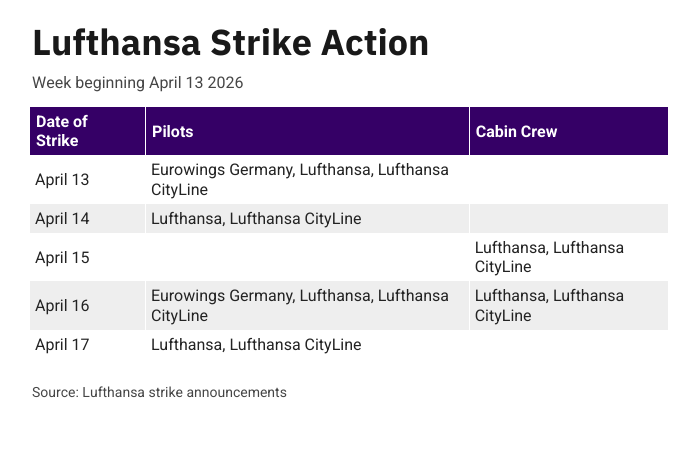
Moreover, it is not coincidental that these accelerated plans have been announced in a week when Lufthansa has seen five consecutive days of strike action:
No problem another AOC can't solve
Given the airline's extended history of challenging labour relations, Lufthansa has progressively diversified its operation by outsourcing capacity to several subsidiaries.
In addition to the mainline airline, four subsidiaries operate capacity sold under the Lufthansa brand:
- Discover Airlines: Leisure-focused short and long-haul network
- Lufthansa CityLine: Regional feeder airline at Frankfurt Airport (FRA) and Munich Airport (MUC) hubs
- Lufthansa City Airlines: Regional feeder airline which began operation from MUC in 2024 and FRA in 2026. Slated to take over operations from Lufthansa CityLine.
- Air Dolomiti: Regional feeder airline at FRA and MUC hubs. Will launch operations from Vienna Airport (VIE) in 2026 on behalf of Austrian Airlines.
(This excludes other operating airlines in the broader Lufthansa Group)
What’s next for each of the operating airlines?
Long story short: growth will increasingly be concentrated at operating airlines with lower labour costs and lower strike risk. No surprise there.
As announced on April 16, Lufthansa CityLine will cease operation with immediate effect. The CRJs will be retired due to "nearing the end of their technical operational capability" and "comparatively high operating costs". It remains to be seen whether the airline's Airbus fleet will be retired or transferred to another airline within the Group.
Meanwhile, the other three operating airlines are all set to expand.
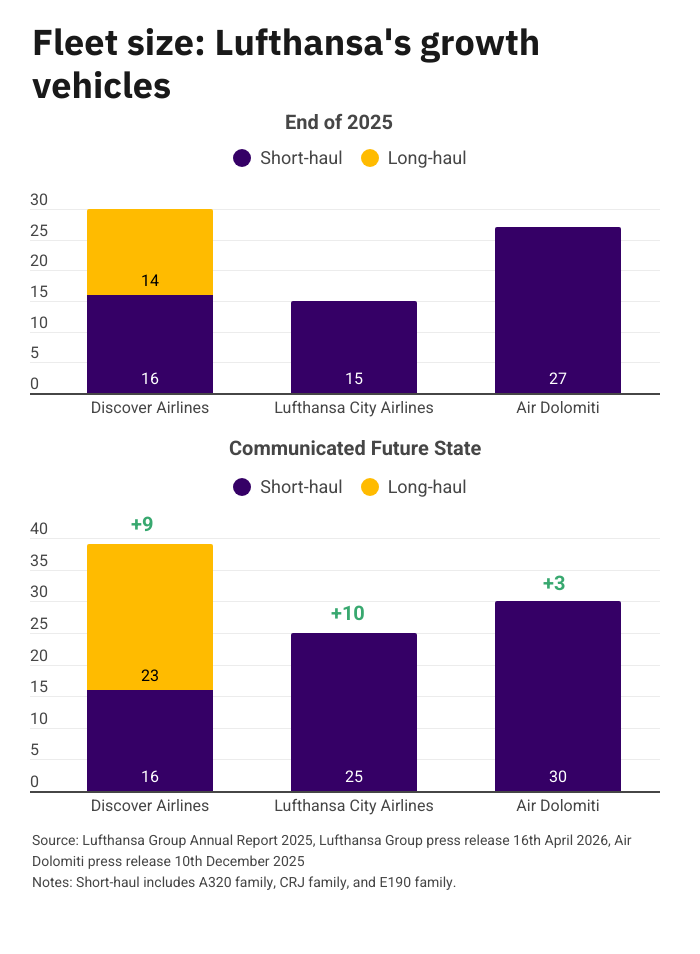
While the exact timeline is unclear, Discover Airlines will grow to at least 39 aircraft with the deployment of 9 x A350-900s. In addition to higher capacity, this will enable the airline to expand its network footprint using the superior range of the A350 compared to the A330.
According to the 2025 Annual Report, Lufthansa City Airlines will induct ten new aircraft into its fleet in 2026 (9 x A320neo and 1 x A220). The airline could now see even faster growth following the accelerated closure of Lufthansa CityLine.
Finally, Air Dolomiti is due retire its fleet of 9 x E190 and take over 13 x E195 from Austrian Airlines, the first of which was transferred in December 2025. This will see the Italian airline grow to a total fleet of 30 aircraft, up from 27 at the end of 2025.
The bottom line
While Lufthansa will still run a more complex operation than its peers and labour relations remain challenging at Lufthansa mainline, there are a number of positive takeaways for the business:
- One less operating airline means a (slightly) simplified operating platform
- Faster retirement of older aircraft (CRJ-900s, A340-600s, 747-400s) means improved fuel efficiency and a more modern product
- Marginal capacity to be cut in a high fuel price environment
Lufthansa's rivals IAG and Air France-KLM both came out from Covid as stronger businesses. It is encouraging to now see Lufthansa also taking faster action on the "tough decisions".
Combined with long-haul fleet and product renewal at the mainline airline, this will hopefully enable Lufthansa to deliver improved performance going forward.


