


Philippine Airlines (PAL) announced on March 30, 2026 that Moody’s Ratings has assigned the airline its first credit rating.
This makes PAL one of only a few airlines worldwide to hold a credit rating. The Engine Cowl dives into what this means and how credit ratings stack up among airlines globally.
Why it matters
A credit rating is a measure of a company’s financial health and, ultimately, its ability to service and repay its debts.
The benefit is that holding a credit rating from at least one of the three main rating agencies - S&P Global, Moody’s, and Fitch - provides expanded access to financing and potentially more favourable cost of capital.
Given the volatility of the airline industry, just qualifying for a credit rating (even if not investment-grade) is no easy task and is already a signal of financial credibility.
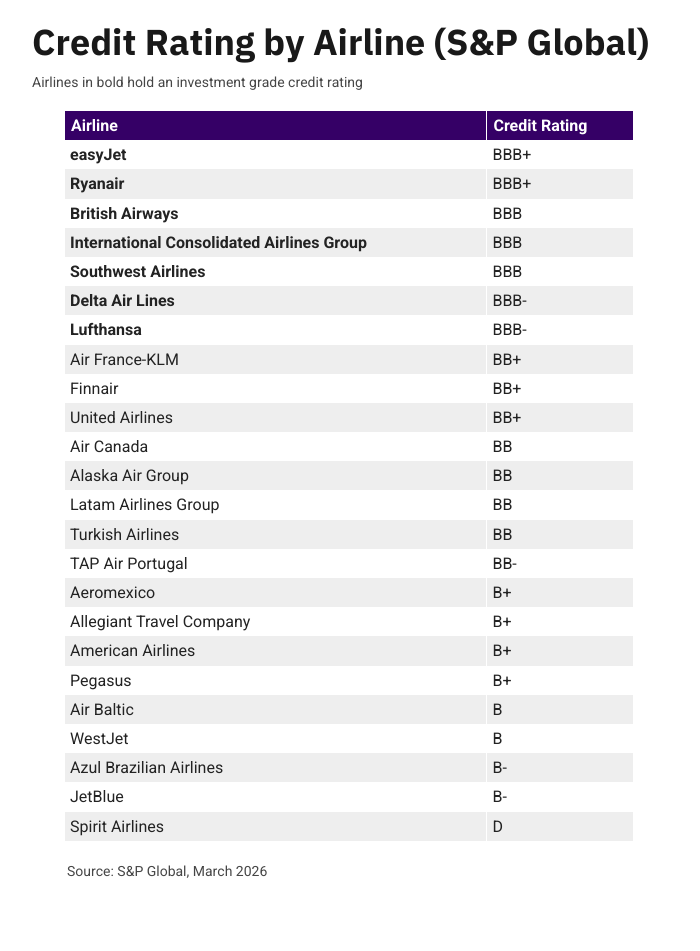
Nevertheless, an investment-grade rating remains the holy grail. Just seven airlines hold an investment-grade credit rating with S&P Global, the largest of the three rating agencies.
United Airlines is, however, taking steps towards becoming the eighth. During the airline’s earnings call held in January 2026, Chief Financial Officer Mike Leskinen reiterated that “becoming investment-grade rated is a major priority of mine”.
How do airlines rank?
On March 5, 2026, S&P Global published the full list of 24 passenger airlines for which it maintains a credit rating.
Key takeaways:
· Unsurprisingly, Ryanair, with its consistently strong earnings and phenomenal balance sheet, tops the list alongside easyJet with a BBB+ rating
· Of the seven investment-grade airlines, five are based in Europe and two in North America (counting IAG and British Airways as separate entities)
· Outside Europe and the Americas, no other airline holds a credit rating with S&P Global (although some airlines are rated by Moody's and/or Fitch and not by S&P Global)
 Rytis Beresnevicius