


Porter Airlines has unveiled two new transborder routes to the United States, with the airline planning to compete with Air Canada in a market that has recently seen lower demand from Canadian consumers.
Moving Toronto City flights to Chicago-O’Hare
On February 18, 2026, Porter Airlines unveiled two new routes from Toronto, which include moving its Chicago-bound flights from Toronto Billy Bishop City Airport (YTZ) to Chicago O’Hare International Airport (ORD).

The Canadian carrier will switch its Chicago flights from Midway International Airport (MDW) to ORD on September 1, offering passengers triple-daily flights. The airline emphasized that the move will facilitate “connecting itineraries” with partner airlines, including American Airlines.
“Porter continues to build frequency and connectivity from Toronto’s downtown airport, providing more options for travellers than any other airline.”
Cirium’s Diio Mi shows that Air Canada will be the only other airline flying YTZ-ORD in 2026, with double-daily departures. Notably, the carrier is a major partner of United Airlines, and both Canadian airlines’ partners are currently engaged in a bitter capacity war at ORD.
However, Air Canada’s route will also be new, with the airline launching its YTZ-ORD services on June 1.
Both carriers will fly YTZ-ORD on De Havilland Canada Dash 8 Q400 turboprops due to YTZ’s ban on jet-powered aircraft taking off from the airport.
According to the Department of Transportation (DOT) data, during the 12-month period to November 2025, Porter Airlines flew 36,120 passengers between YTZ and MDW, with an average load factor of 66%.
 Rytis Beresnevicius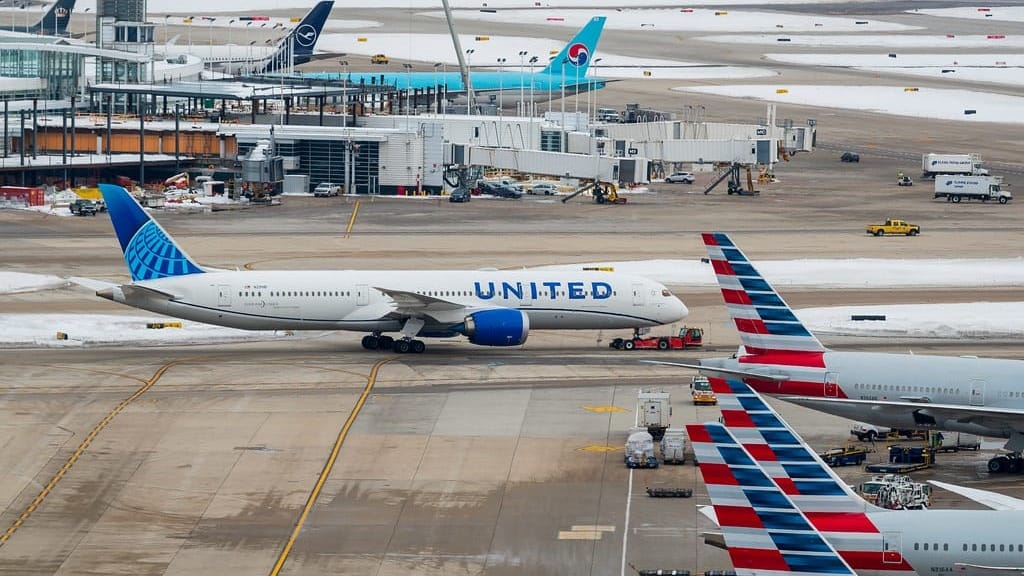
Breaking Air Canada’s monopoly on flights to Austin
Porter Airlines’ second new route will see its Embraer E195-E2s fly from Toronto Pearson International Airport (YYZ) to Austin-Bergstrom International Airport (AUS). Starting on May 21, the airline will offer five weekly departures.
In comparison, Air Canada serves AUS daily from YYZ, using a similarly sized aircraft, the Airbus A220-300. During the 12-month period up to November 2025, the Canadian airline’s cabins were, on average, 78% full, per DOT data, which was compiled by Cirium’s Diio Mi.
Porter Airlines’ E195-E2s welcome up to 132 passengers, including 36 extra legroom seats, while Air Canada’s A220-300s can seat up to 137 travelers. The A220-300 aircraft also has 12 business class seats in a two-two configuration, offering Air Canada premium yield opportunities, including on such routes where the two airlines will compete against each other.
Both Air Canada and Porter Airlines will be growing their US-Canada networks. For example, in June, Porter Airlines will grow US seat capacity by 11% compared to last year, while Air Canada will grow by 11%.
At the other end of the spectrum, Air Transat will end its already limited US operations, while WestJet, despite also having a close-knit relationship with Delta Air Lines, will cut its transborder departing weekly seats by 14% during the month.
During Air Canada’s Q4 2025 earnings call, Mark Galardo, the Chief Commercial Officer (CCO) and President of Cargo at the airline, clarified that in 2026, the carrier expects the transborder market to maintain its status quo and neither “get any worse” nor “get any better.”
“However, what’s kind of in our favor right now is the demand capacity balance is very much in our favor. […] Again, that supports, you know, kind of a constructive backdrop for rebound in transborder revenue for us this year.”
 Rytis Beresnevicius