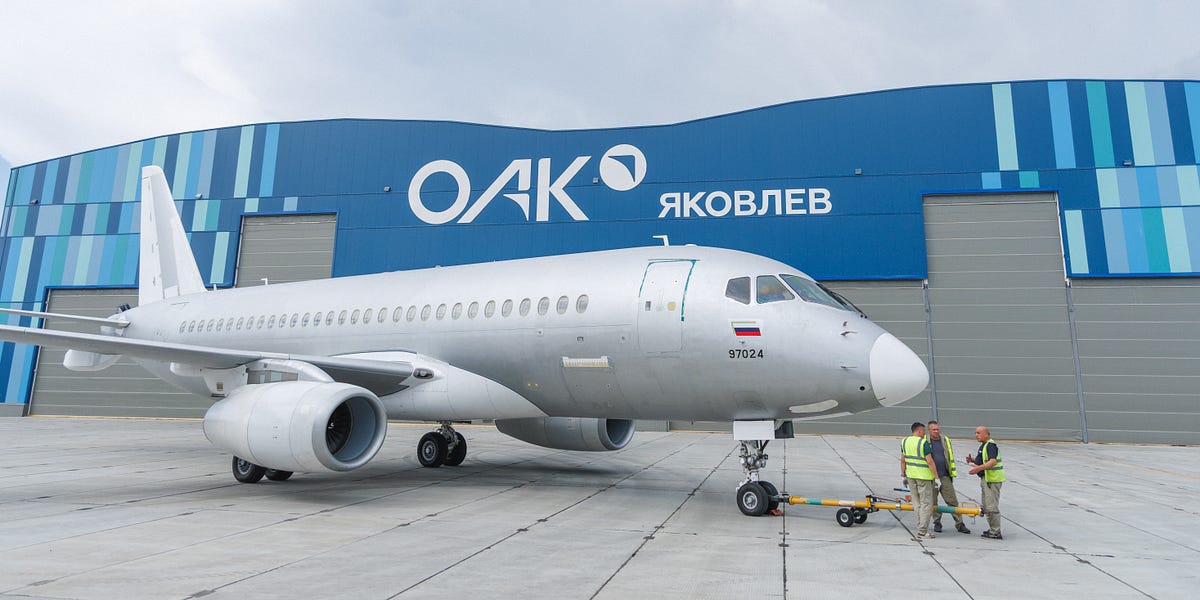


Rostec, the parent company of the United Aircraft Corporation (UAC), which itself is the parent company of Russian aerospace manufacturers, has announced that the second Russified MC-21 has begun flight testing.
On November 27, 2025, Rostec said that the second MC-21 began certification testing at Zhukovsky International Airport (ZIA), with the first flights involving checks of the aircraft’s “stability and controllability,” using Russian-made “control system actuators.”
The second Russian-made MC-21 was piloted by a crew of five pilots and engineers.
According to Anatoly Gaidansky, the First Deputy Managing Director and Director of the Engineering Center at Yakovlev, the addition of a second airframe to the program will allow the company to “intensify the testing program currently underway in Zhukovsky for another MS-21 prototype, partially equipped with new Russian systems and components.”
“Our primary objective is to complete all testing under the import substitution program and obtain the necessary approval for the major modification for subsequent aircraft deliveries to airlines.”

Rostect pointed out that this specific airframe flew from Irkutsk Northwest Airport to ZIA on November 13, with factory development flights preceding the beginning of the flight tests. The flight lasted more than six hours, with the MC-21 reaching a maximum altitude of around 11,000 meters (36,000 feet).
According to the company, the MC-21’s components, which were previously made by Western-based suppliers, were replaced with Russian-made parts, including “the cockpit controls, control system actuators, wing high-lift system, stabilizer trim mechanism, avionics suite, integrated air conditioning system, integrated flight data collection, monitoring, processing, and recording system, wheel braking system, cruise and auxiliary power units, fuel system, wheels, tires, and others.”
The first domesticated MC-21 airframe made its first flight on April 29, and on June 26, Rostec announced that it had begun certification tests. At the time, Vitaly Naryshkin, the Chief Designer of the MC-21, said that Yakovlev plans to conduct around 220 to 230 flights to ensure “100% safety for our future passengers.”
TASS, the Russian news agency, reported that according to Sergei Chemezov, the Chief Executive Officer (CEO) of Rostec, the MC-21 should be certified by the end of 2026.
Russia has been forced to explore ways to mass-produce its own aircraft, including the MC-21 and the Russified SJ100, based on the Sukhoi Superjet 100, following its invasion of Ukraine in February 2022.
As a result of the war, which has claimed the lives of thousands of Ukrainian civilians, Russia and many of its industries, including aerospace, have been sanctioned by Western governments, cutting off the country’s access to Western-made aircraft components.
Russian airlines also illegally re-registered hundreds of aircraft, owned by Western companies and aircraft lessors, in the country, with only a handful returning to their rightful owners.
In June, the United Kingdom High Court of Justice ruled in favor of six aircraft leasing companies, which had ‘lost’ aircraft in Russia, concluding that the lessors may recover their losses associated with the aircraft from their insurers.
AerCap, one of the leasing companies, highlighted in its Q2 financial results release that it was awarded around $1 billion “from the war risks insurers of our contingent and possessed insurance policy by the London Commercial Court in respect of assets lost in Russia in 2022.”
 Rytis Beresnevicius