

Southwest Airlines, in the words of a rival’s chief executive, has been the airline that “has done the most” in terms of making changes in the past year. Now, the carrier’s executives used an investor conference to have a conversation about those changes, and how Southwest Airlines is balancing shareholder returns and what customers want.
Delivering for shareholders and customers
Unlike other airlines, whose executives appeared at the J.P. Morgan Industrials Conference on March 17, 2026, Southwest Airlines did not bring a presentation or issue an update on its Q1 2026 results guidance.

Instead, according to Bob Jordan, the Chief Executive Officer (CEO) of Southwest Airlines, he wanted to have “a conversation and talk to you about what is going on in Southwest.”
Jordan described 2025 as the “most transformational year in the history” of the airline, outlining that the company changed its product, added different revenue streams, and additional distribution channels.
So far, the transformation has gone “very, very well.” Jordan outlined that first, customers are buying the new products, and second, it has lifted Southwest Airlines’ revenue performance.
“There is broad-based revenue strength, but we are seeing specific revenue strength in the new initiatives and products that we are selling at Southwest.”
According to Jordan, at the end of the day, shareholder returns “is what matters.” At the same time, “this whole thing is about driving to meet the needs of the customer in 2026 and beyond,” he added later on, when answering a question from the bank’s analyst.
“Our customers want product choice. Our customers want an evolution of our product, power at every seat back, the larger bins, extra legroom options, and so it is all about meeting the customers' needs.”
 Rytis Beresnevicius
Southwest Airlines’ value proposition
Jordan also explained what kind of value proposition Southwest Airlines had in the past, and what it offers now. Previously, policy was the name of the game, namely that bags fly free was a policy, and so were never-expiring flight credits.
“Customers are going to choose you in part for that, but in a large part for do you offer the product that I want? There's more demand for product differentiation than ever. Do you fly and have a nonstop [to] where I want to go?”
Making changes to its product, including assigned seating, “meant to attack that and make the product more relevant to our customers, which means they're going to want to get the credit card.”
Lounges are another thing that is on the airline’s and its customers’ priority list, but Jordan had nothing more to share except that Southwest Airlines will build lounges only if it “makes sense from a financial threshold perspective.”
While there have been few details on the potential lounge network, the airline did ask the Hawaiian Department of Transportation (HDOT) for approval for lounge space at Honolulu Daniel K. Inouye International Airport (HNL).
On January 8, HDOT amended the lease request, including the potential space of the lounge. The Department also added a rent waiver for 12 months, “provided that the waiver of rent shall be conditioned on Southwest making substantial improvements to the spaces.”
Nevertheless, Jordan highlighted that one of Southwest Airlines’ largest advantages, if not the largest, “is service and our people,” proven by the fact that it has the highest net promoter score (NPS).
“[…] the one completely outstanding difference is our people, the way they make you feel, and the service that they provide, in particular on the aircraft.”
 Rytis Beresnevicius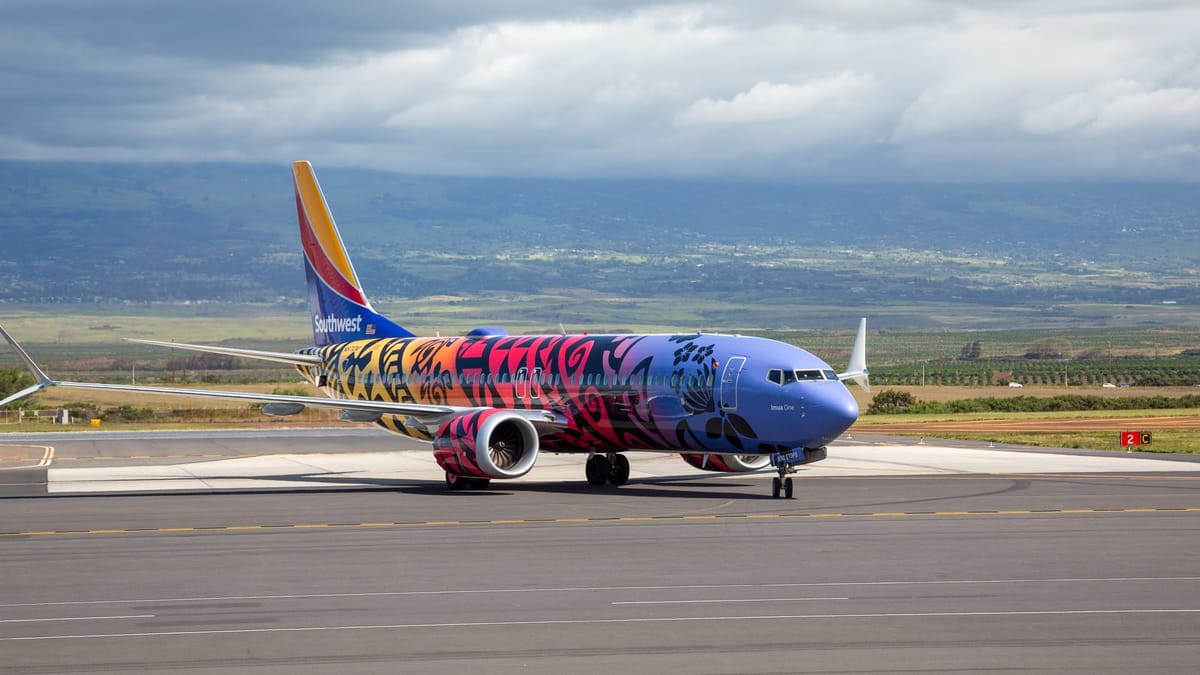
Capturing premium revenue
One of the primary trends in the United States airline market is that airlines, ranging from Delta Air Lines to Spirit Airlines, are increasingly leaning into the premium customer. Southwest Airlines is no exception, and according to Jordan, it is “focused on optimizing the products that we have just put in place and seeing the optimal benefit” in terms of additional revenue.
“The products are performing terrific, both from a demand and a pricing perspective, but we have an opportunity to continue to optimize that. Based on those learnings and [market] share and where we might need to look, we will continue to look at other more premium [products].”
Jordan added that if you were to look at the airline’s guidance, it would imply that Southwest Airlines’ “operating margins would be back in the hunt at being top of [the] industry.”
That is important, according to the CEO, who noted that in the past, there was widespread belief that you could only do so if you had premium and long-haul international products.
But those rising margins tell the story about the carrier’s “underlying product strength, which is the best domestic network, the best people and best service, the best operation,” and a much more appealing product onboard the aircraft, even if Southwest Airlines does not have long-haul international or a first class cabin at the front of the aircraft.
“And we are in the hunt to have top-of-industry margins. It tells you something about the strength of the underlying product even absent those two things.”
Andrew Watterson, the Chief Operating Officer (CCO) of Southwest Airlines, added that corporate clients are also “responding well on the price side and the volume side.”
“In fact, for March, if we did not sell a dollar more of corporate travel, March would be our biggest corporate travel month in our history as of last Friday, and we still have half the month to go, and corporate books close in, as you know, so quite the momentum.”
But what about the naysayers, who have been pretty vocal and negative about the changes Southwest Airlines has made, including, for example, not allowing passengers to move into empty seats on a flight? Jordan responded,
“I would put that in a very small but sometimes noisy category, but it is a very small percent of all folks that are flying. As you know, social media has a tendency to amplify things.”
 Rytis Beresnevicius