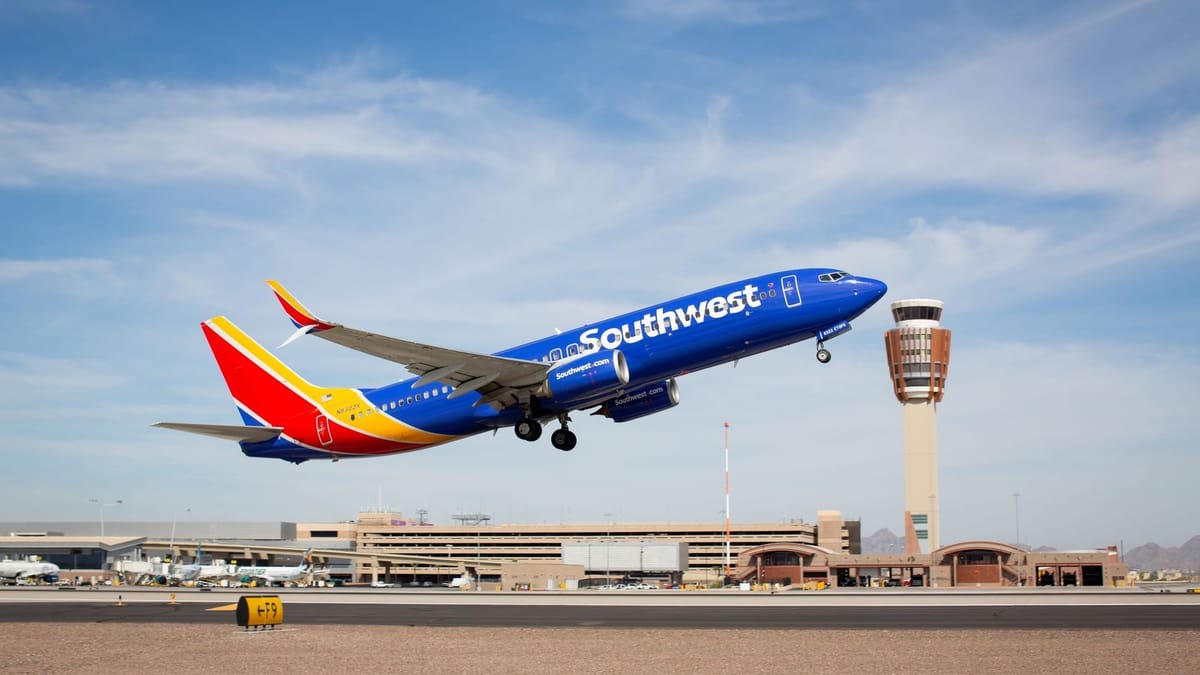


In an update to investors, Southwest Airlines has disclosed that due to the United States government shutdown and higher fuel prices, its full-year earnings before interest and taxes, excluding special items (EBIT) guidance was revised by $100 million to $300 million.
On December 5, 2025, Southwest Airlines published an update regarding its full-year EBIT guidance, saying that as a result of lower revenues due to the “government shutdown, and the impact of higher fuel prices, the Company now expects its full year 2025 EBIT to be approximately $500 million.”
Its previous guidance estimated that the airline’s full-year EBIT would be between $600 million and $800 million.
However, Southwest Airlines said that while the carrier had observed a “temporary decline in demand related to the shutdown,” it has since normalized.
The airline was not the only US carrier that had disclosed a financial impact following the government shutdown. On December 2, JetBlue said that the shutdown, Hurricane Melissa, and the mandated software and/or hardware updates to Airbus A320 aircraft had negatively impacted its quarterly capacity growth plans, adding that it has continued to evaluate “any potential financial impact.”

Just before Ed Bastian, the Chief Executive Officer (CEO) of Delta Air Lines, made an appearance at the Morgan Stanley Global Consumer & Retail Conference on December 3, the airline published a Securities and Exchange Commission (SEC) filing that detailed its shutdown-related pre-tax profit impact was around $200 million.
“Growth in travel bookings has returned to initial expectations following a temporary softening in November related to the government shutdown,” Delta Air Lines said.
 Rytis Beresnevicius
Lastly, Alaska Airlines also filed an update with the SEC on December 3, saying that instead of an expected adjusted earnings per share (EPS) of at least $0.40, it now expects to end the quarter with an EPS of around $0.10.
“Several transitory headwinds totaling approximately $0.55-0.60 per share impacted the quarter, including: an internal IT and cloud service provider outage ($0.25), lost revenue due to the government shutdown ($0.15), higher fuel costs ($0.15), and a higher book tax rate for the quarter.”
Following the latest IT outage in October, the airline contracted a third-party to audit its IT infrastructure, with Alaska Airlines actively “implementing best-practice recommendations to strengthen our data center resiliency.”
The carrier’s capacity, measured in available seat miles (ASM), should be up 2% year-on-year (YoY). Its guidance initially outlined that pro forma, Q4 capacity should have been up 2% to 3%. “The government shutdown that began in October drove FAA-mandated flight reductions, resulting in around 600 cancellations across Air Group, impacting approximately 40,000 guests,” Alaska Airlines pointed out.
“Revenue, which had shown the strongest year-over-year performance trends of 2025 prior to the shutdown, turned sharply negative during the period and, although now positive again year-over-year, has not fully recovered to pre-shutdown trends.”
Still, Alaska Airlines remained positive, noting its progress on integrating Hawaiian Airlines. Excluding the transition impacts, the company should end the year with unit costs aligned with its original expectations while also “making tangible progress in narrowing the unit revenue gap versus larger network peers.”
 Rytis Beresnevicius