

Spirit Airlines, after not publishing a monthly operating report for the month of December 2025, has filed its annual financial report, detailing that, combined, the predecessor company and the successor, following its first Chapter 11 bankruptcy, lost $2.7 billion in 2025.
Growing losses
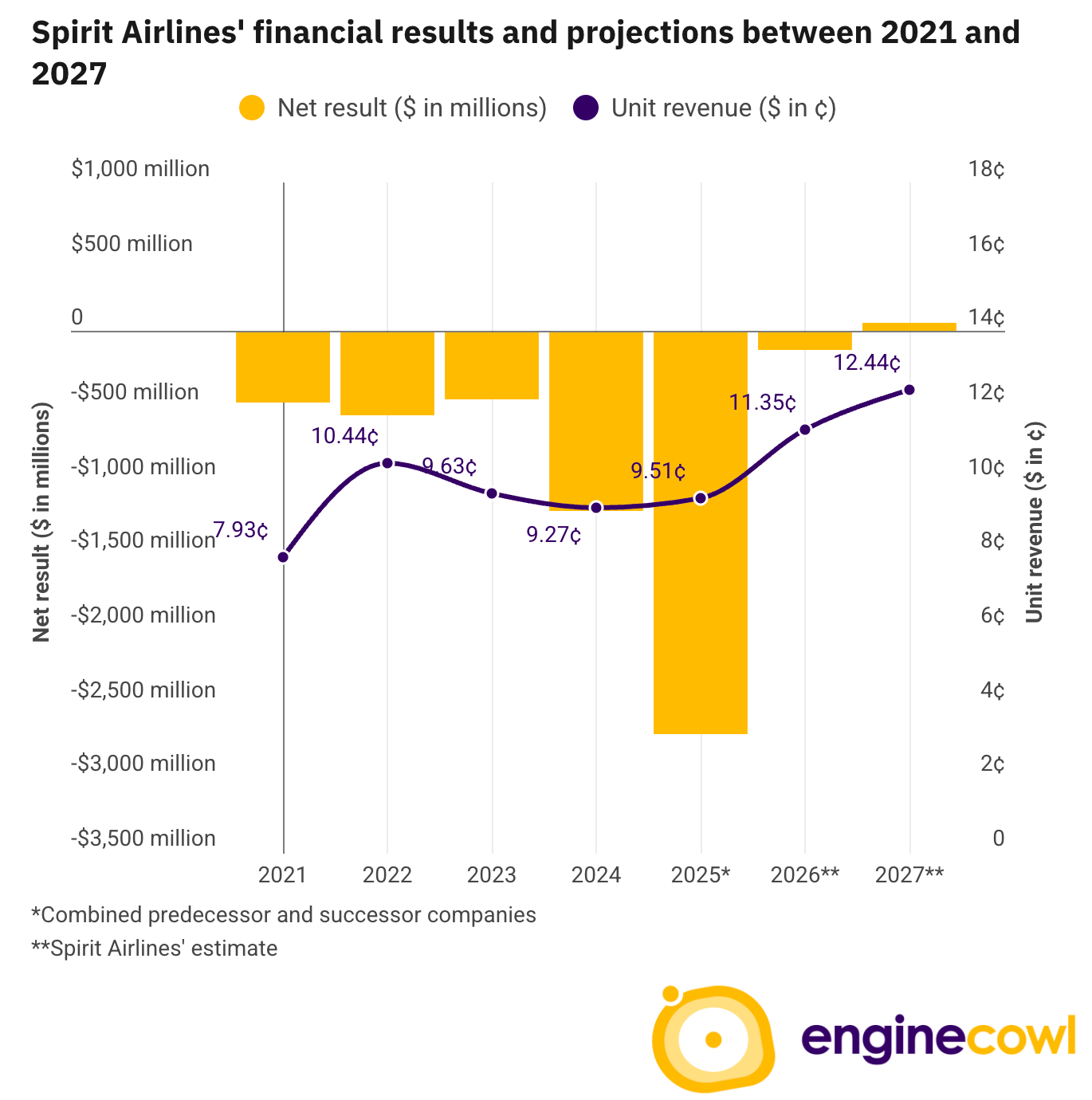
On March 16, 2026, Spirit Airlines published its annual 2025 report, detailing that the company, which was shuttered during its first Chapter 11 bankruptcy case, which ended in March 2025, and the succeeding company, lost a combined $2.7 billion in 2025.

Interestingly, the predecessor was profitable between January 1, 2025, and March 12, 2025, posting a net profit of $72.2 million during that period. However, that iteration of Spirit Airlines had an operating loss of $287.1 million, after it had recognized restructuring gains of $421.6 million, resulting in a non-operating income of $377.2 million.
The successor carrier delivered an operating loss of $481.5 million between March 13, 2025, and December 31, 2025, and a net loss of $2.8 billion. It recognized $2.1 billion of reorganization-related expenses during the period.
In addition, the succeeding Spirit Airlines used $706.5 million of cash during the almost-nine-month period for its operations, benefiting up to $384.8 million from investing activities, including the sale of property and equipment.
At the end of 2025, the low-cost carrier held $864.3 million of cash, cash equivalents, and restricted cash.
(The combined predecessor and successor companies’ results are a non-Generally Accepted Accounting Principles (GAAP) measure.)
Higher per-passenger revenues
Spirit Airlines detailed that in 2025, it significantly reduced its capacity, aircraft utilization, and the number of departures. All three measures fell by at least 22%.
The airline’s capacity, measured in available seat miles (ASMs), was down 24.7% year-on-year (YoY), while the number of departures fell to 217,213, a 22.2% reduction compared to 2024. Average aircraft utilization was 7.7 hours, or 22.2% lower than in 2024.
“The reduction in capacity was primarily driven by a lower number of aircraft available for service due to GTF engine issues, previously grounded aircraft held for sale, and other strategic initiatives, including reductions in flying on off-peak travel days to better align capacity with market demand.”
This did result in total revenue per ASM (TRASM), or unit revenue, climbing 2.6% YoY. At the same time, not only did the load factor drop by 4 percentage points to 78.4%, but the cost per ASM (CASM) was 0.7% higher YoY.
Adjusted CASM, excluding fuel (CASM-ex), was also up 15.9% YoY, and was only slightly lower than TRASM: 9.51¢ versus 9.24¢. Fuel unit costs were 10.4% lower than in 2024.
Path to profitability
In a separate filing on March 15, Spirit Airlines detailed its post-bankruptcy plans to return to profitability in 2027. While it estimated a net loss of $111 million in 2026, including cash burn until at least October, the airline plans to be cash-positive throughout 2027.
That also includes an estimated $55 million net profit in 2027, on the back of $2.6 billion in revenue. Spirit Airlines expects to earn $3 billion in revenue in 2026. In comparison, the two combined entities earned $3.7 billion in revenue in 2025.
Spirit Airlines estimates its unit revenue will be 11.35¢ in 2026 and 12.44¢ in 2027, with CASM-ex at 8.86¢ and 9.08¢, respectively.
The key pillars of its plan are to slash its fleet from 214 aircraft pre-bankruptcy to 76 post-bankruptcy, expand premium capacity, build revenue management infrastructure using a new revenue management platform, and introduce new products, including a new bundle and save feature, resulting in additional ancillary options.
We reported on the post-bankruptcy plan in more detail here:
 Rytis Beresnevicius