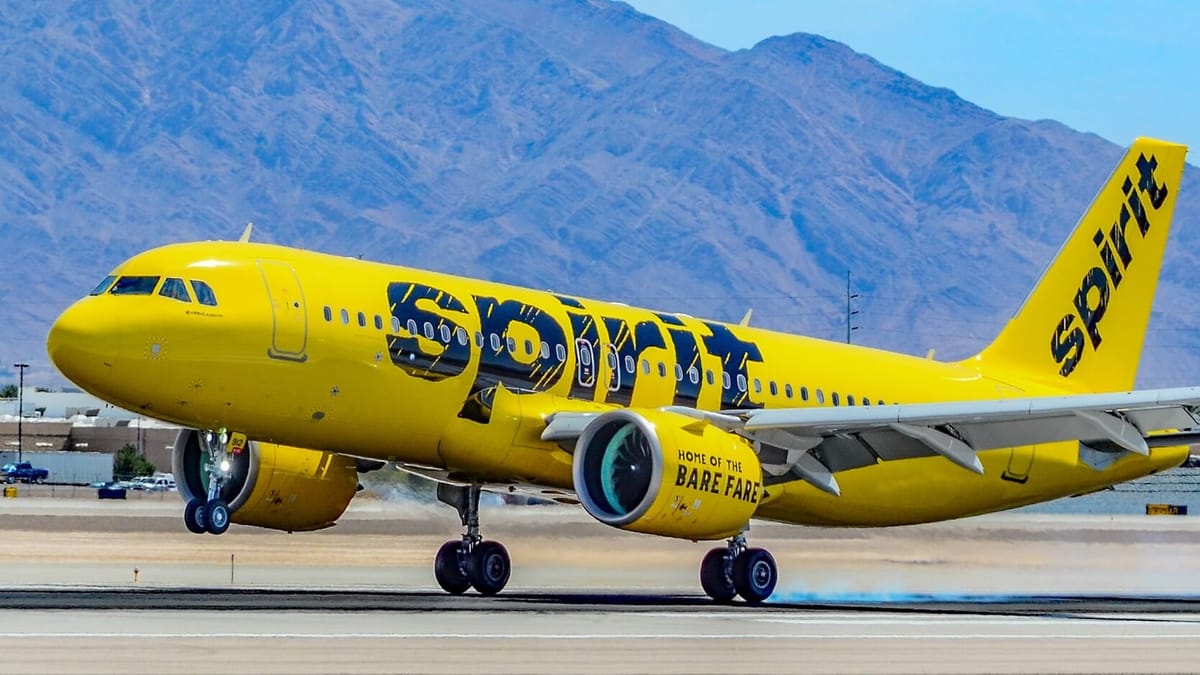


In a restructuring term sheet agreement between Spirit Airlines and International Aero Engines (IAE), which is a joint venture between Pratt & Whitney, MTU Aero Engines, and Japanese Aero Engine Corporation, the low-cost carrier has committed to operating up to 106 Airbus A320 family aircraft as of the effective date of its Chapter 11 bankruptcy plan.
On December 3, 2025, Spirit Airlines filed a motion with the United States Bankruptcy Court for the Southern District of New York to get approval for its restructuring term sheet with IAE, which supplies engines such as the IAE V2500 and Pratt & Whitney PW1100G.
Both are used by Spirit Airlines to power its A320ceo and A320neo family aircraft, respectively.
The restructuring term sheet between the two was a result of the settlement between the airline and the engine manufacturer related to the airline’s fleet, debts to International Aero Engines, and PW1100G engines that the carrier will lease in the future.
According to the proposed motion, IAE would provide Spirit Airlines with $140 million of credits, which “may be used to pay amounts due and owing to the IAE Parties and certain other parties.” The sheet also outlined that as of December 1, the airline has a confidential amount of oustanding invoices on its accounts with IAE, with Spirit Airlines agreeing to settle the invoices by applying a confidential amount of said credits and cash, provided that both parties “will reserve all rights to make, and any and all defenses with respect to, claims as to the pre-petition and post-petition allocation, and priority, of the obligations relating to such outstanding invoices.”

Spirit Airlines will also get access a confidential number of new spare PW1100G engines, with monthly deliveries beginning on a confidential date. The low-cost carrier will also have to comply with a confidential ratio of spare and installed PW1100G engines.
However, the – subjectively – most important and interesting part of the restructuring term sheet was Spirit Airlines’ fleet commitments. Since it declared its second Chapter 11 bankruptcy on August 29, it has been clear that the airline wants to reduce its fleet and redesign its network in order to return to profitability and ensure its long-term future.
The restructuring term sheet outlined that, as of the effective date of its Chapter 11 plan, which the airline has yet to present following a request to extend the plan’s filing deadline, Spirit Airlines agreed to retain a leased fleet of no less than 10 and no more than 28 A320neo family aircraft, both A320neo and A321neo, “with all other leased A320neo family aircraft and associated PW1100G-JM engines to be removed from Spirit’s fleet by the Chapter 11 Plan Date,” and at least 78 A320ceo aircraft, which are either leased or owned by the carrier.
“[…] all other A320ceo family aircraft and associated V2500 engines in Spirit’s fleet as of the Petition Date to be removed from Spirit’s fleet by the Chapter 11 Plan Date.”
That means that Spirit Airlines could fly anywhere between 88 and 106 A320ceo and A320neo family aircraft as of the effective date of its restructuring plan, resulting in the airline planning to slash its fleet size to almost half its current size.
 Rytis Beresnevicius
When it published a detailed Q3 financial report on December 2, the low-cost carrier said that as of September 30, it had a fleet of 214 aircraft, 148 of which were financed via operating leases with an expiration date of between 2026 and 2043. Another 48 aircraft were owned by the company, and it also had “18 aircraft that would have been deemed finance leases resulting in failed sale leaseback transactions.”
In support of the restructuring term sheet, Fred Cromer, the Chief Financial Officer (CFO) of Spirit Airlines, explained that after RTX, the parent company of Pratt & Whitney, disclosed the powder metal issue that affected specific PW1100G engines, powering A320neo family aircraft, the condition has caused “significant disruptions to” the operation of Spirit Airlines’ affected aircraft.
Before the second Chapter 11 bankruptcy, the airline and Pratt & Whitney “entered into an agreement that provided the Debtors with monthly credits, subject to certain conditions, through the end of 2025 in respect of the Debtors’ grounded aircraft.”
“Thereafter, [Spirit Airlines] and the IAE Parties remained engaged in further arms’-length negotiations, with sophisticated advisors, over the terms of a final settlement of the [airline’s] claims against Pratt & Whitney in connection with GTF engines and the rejection of leases for A320 family aircraft powered by IAE engines as part of the Debtors’ fleet optimization process.”
The negotiations had culminated in the restructuring term sheet, Cromer said.
According to the CFO, the benefits of the sheet “are substantial,” and will “maximize value for the benefit of all creditors.” As such, the parties requested the court to hold a hearing on December 16 in order to enable IAE to “settle the outstanding invoices and related credits, and book certain related payments from contract counterparties, by the end of the year.”
 Rytis Beresnevicius