


On April 9, TAP Air Portugal (TAP) released its financial results for 2025. The Engine Cowl looks at the key takeaways.
Slightly falling margins
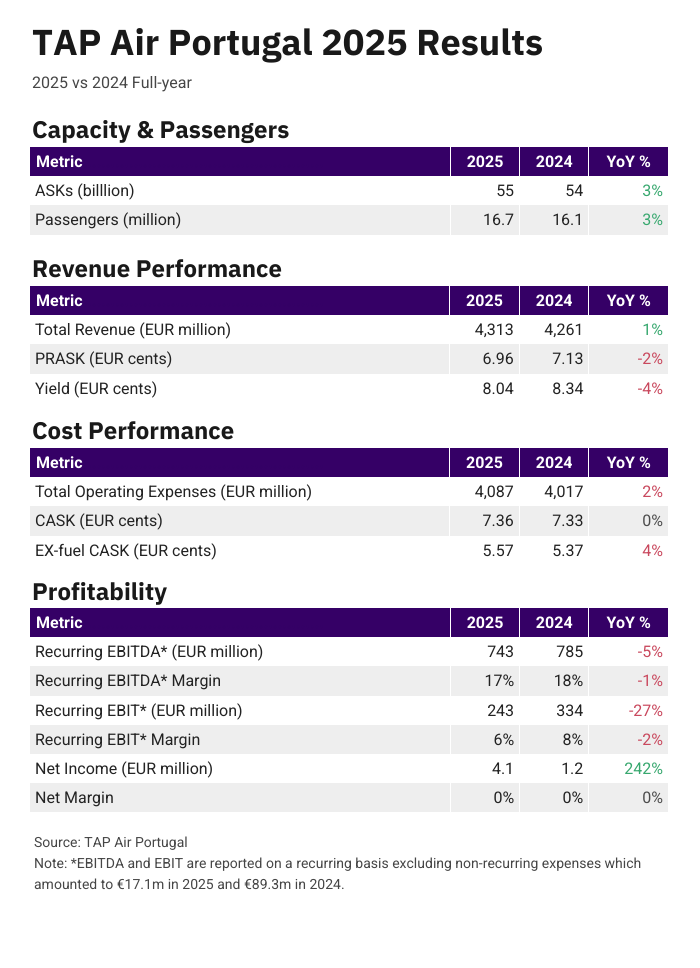
TAP delivered a 6% Recurring EBIT margin in 2025, down from 8% in 2024.
This was due to Passenger Revenue per ASK (PRASK) coming in 2% below last year while total CASK was flat.
The decline in PRASK was driven by a 4% fall in yields which was partially offset by 2% higher load factors. Lower PRASK was relatively broad-based with almost all regions seeing a fall in unit revenue. Africa was the exception with 7% YoY growth in PRASK on flat capacity.
The airline’s net profit was adversely impacted by a €42 million ($49 million) non-cash charge from remeasurement of deferred tax assets and liabilities as a result of a one-point reduction in the corporate income tax rate.
Partial fuel hedge leaves TAP exposed to oil price swings
TAP’s forward fuel hedge coverage was reported as follows:
- 50% for Q1
- 47% for Q2
- 32% for Q3
- 30% for Q4
Considering the recent increase in fuel prices, this leaves the airline partially exposed to the recent increase in fuel prices.
Nevertheless, the airline's relatively young fleet and high share of neo technology aircraft will help to mitigate the fuel price impact compared to airlines with an older fleet mix.
Fleet to grow by 5-7 aircraft in 2026
TAP plans to add the following aircraft to its fleet in 2026:
- 6 x A320neo
- 2 x A321neo
- 2 x A330neo
The carrier expects its fleet to grow from 99 aircraft at the end of 2025 to 104-106 aircraft by the end of 2026. Consequently, the neo share of the fleet will increase from 71% in 2025 to 74% in 2026.
The new aircraft will help to fuel growth in Porto (OPO) where TAP will launch new services in 2026 to Praia (RAI), Tel Aviv (TLV), and Terceira (TER). Lisbon (LIS) will also see new routes to Athens (ATH), Curitiba (CWB), Orlando (MCO), and Sao Luis (SLZ).


