


Air Baltic has announced a reversal of its post-covid growth strategy, aiming to shrink its fleet, grow revenue, and ultimately deliver an EBITDAR margin in excess of 25%.
Air Baltic's turnaround plan
- Refocus the network on the Riga hub
- Reduce fleet size from 54 aircraft to 36 by the end of 2026
- Cut scheduled capacity by 10%
- Continue ACMI operations with a more balanced summer/winter split
The new business plan will be accompanied by a financing package in which the airline is seeking €225 million in debt financing and €100 million in new equity.
How did Air Baltic get to this point?
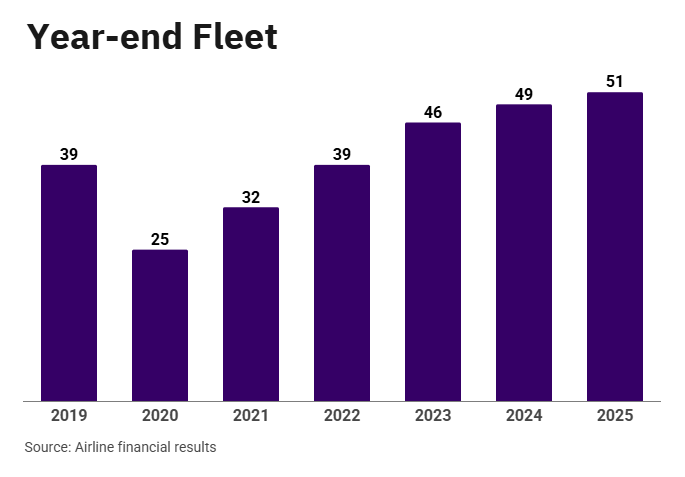
Air Baltic has substantially grown its fleet in recent years. The airline went into Covid with a 2019 fleet of 39 aircraft. A year later, the fleet had been reduced to 25 aircraft.
Since then, the fleet size has more than doubled to 54 aircraft today.
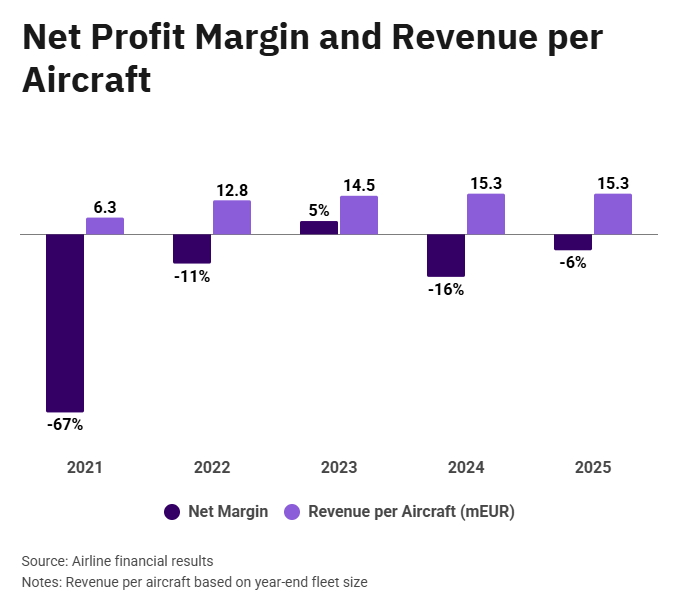
Meanwhile, the airline has remained structurally unprofitable. 2023 was the only recent year in which it turned a net profit.
Revenue per aircraft currently stands at approximately €15 million with a typical net loss per aircraft of €1-2 million. Considering today’s elevated fuel prices, revenue per aircraft probably needs to reach at least €20 million to cover increased operating expenses and deliver a sustainable business.
What does Air Baltic’s network look like today?
Air Baltic’s network is focused on its Riga hub where the airline holds a 2026 market share of 63% in terms of seat capacity, ahead of Ryanair on 18%. Wizz Air closed its two aircraft Riga base in 2021 and pulled out of the Latvian market entirely last year.
Although Latvia accounts for about two-thirds of its network, Air Baltic has also developed a presence in neighbouring Baltic markets, ranking #1 in Estonia with a 29% market share and #3 in Lithuania with a 15% market share (behind Ryanair and Wizz Air).
A handful of winter sun routes are operated from the Canaries to points outside the Baltic region in order to help balance seasonality. Some of these winter sun markets have already been culled following the announcement of the new business strategy.
ACMI operations play an increasingly important role for Air Baltic, accounting for just over 20% of revenue in 2025. This business segment is, however, quite seasonal with 19 aircraft leased out during Q2 and Q3, compared to 12 aircraft in Q4 and only six in Q1 (2025 figures).
Has Air Baltic's fleet outgrown its core market?
Instinctively, a 54 aircraft national airline for a middle-income country of just under 2 million people seems excessive.
Let’s look at whether the data supports that hypothesis:
Departing seats per capita from Latvia come in at 2.33 which is actually below the European Union (EU) average of 2.97.
However, Latvia produces 80 departing seats per $1 million of GDP which is above the EU average of 63. Other countries with high seat capacity relative to GDP are mostly on the Mediterranean with significant tourism flows to drive demand.
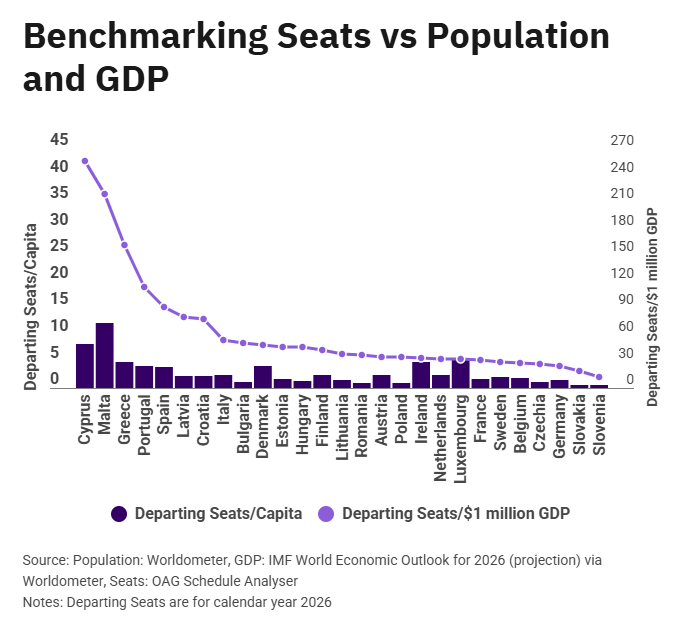
The fact that 20% of Air Baltic’s operation is dependent on ACMI business is symptomatic of a fleet that most likely outgrew its profitable network.
It is also worth noting the impact of the war in Ukraine on Air Baltic’s network. In 2019, Russia, Ukraine, and Belarus accounted for 17% of Air Baltic’s capacity out of Latvia.
That’s a sizeable chunk of the network to lose, particularly considering those markets would have been among the more natural flows for connecting traffic over Riga given Latvia’s geographic position in the north-east corner of Europe.
A220 fleet groundings driving up unit costs
Like other A220 operators, Air Baltic has been forced to ground aircraft as a result of accelerated engine removals.
This resulted in relatively low aircraft utilization of 8.4 block hours/day in 2025 and will have artificially increased unit costs.
Having said that, the groundings may have been somewhat of a double-edged sword given Air Baltic’s network isn’t crying out for more capacity.
Will shrinking the fleet get Air Baltic back on track?
At 54 aircraft, Air Baltic’s fleet size is probably too large relative to its home market.
That's why it has had to pivot to growing ACMI operations and new markets outside Latvia.
Throw in the impact of high fuel prices, off-wing GTF engines, and the loss of 17% of its pre-Covid network due to the war in Ukraine, and you have a challenging business.
Reducing the fleet size seems like a no-brainer for Air Baltic and the most critical step the airline can take to recover financial performance.
Combined with more balanced ACMI operations, a smaller fleet should enable the right-sizing of the network to focus on more profitable markets and ultimately generate €20 million revenue per aircraft.
In recent years, Virgin Australia and Norwegian have both recovered performance by refocusing on their core business and jettisoning the more exotic elements of their network.
What other levers can Air Baltic pull?
Lufthansa Group already owns 10% of Air Baltic alongside majority-owner the government of Latvia.
Air Baltic could potentially benefit from closer integration, particularly with Lufthansa's loyalty program Miles & More.
Folding Air Baltic’s existing loyalty program into Miles & More could drive incremental demand by tapping into Lufthansa’s frequent flier base in a similar fashion to LOT Polish Airlines or Luxair.
There will also be opportunities to drive higher ancillary revenue, either optimizing existing revenue streams or introducing new ones, particularly where novel products can add value to the customer journey.
The long-term outlook
Between right-sizing the fleet and balancing ACMI operations, Air Baltic has a plan to go forward within the runway of its proposed refinancing.
Nevertheless, being an independent airline in Europe is no easy task and other carriers with arguably stronger fundamentals have gradually consolidated into larger group structures.
It would be surprising if in ten years’ time Air Baltic had not followed a similar path to integrate into one of the network carrier groups.
Photo credit: MarcelX42 via Wikimedia Commons
Data credit: Capacity data supplied by OAG Schedule Analyser
 Garth Lund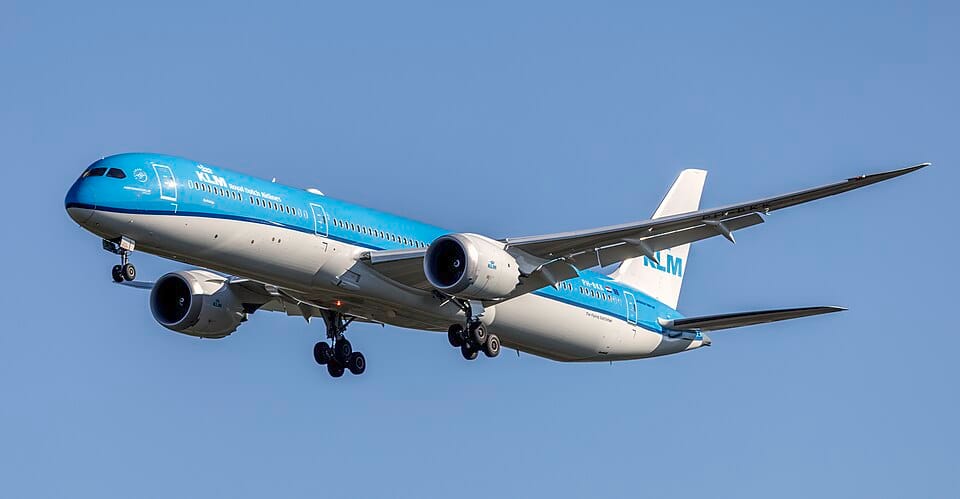


.jpg?ref=enginecowl.com)