


Volotea has typically maintained a lower profile than some of its LCC peers. But in September 2026, the Spanish airline filed for preliminary creditor protection in Barcelona after the Iran conflict added €150 million to its fuel bill.
What does that mean for the airline and its network?
Consistent growth since founding in 2012
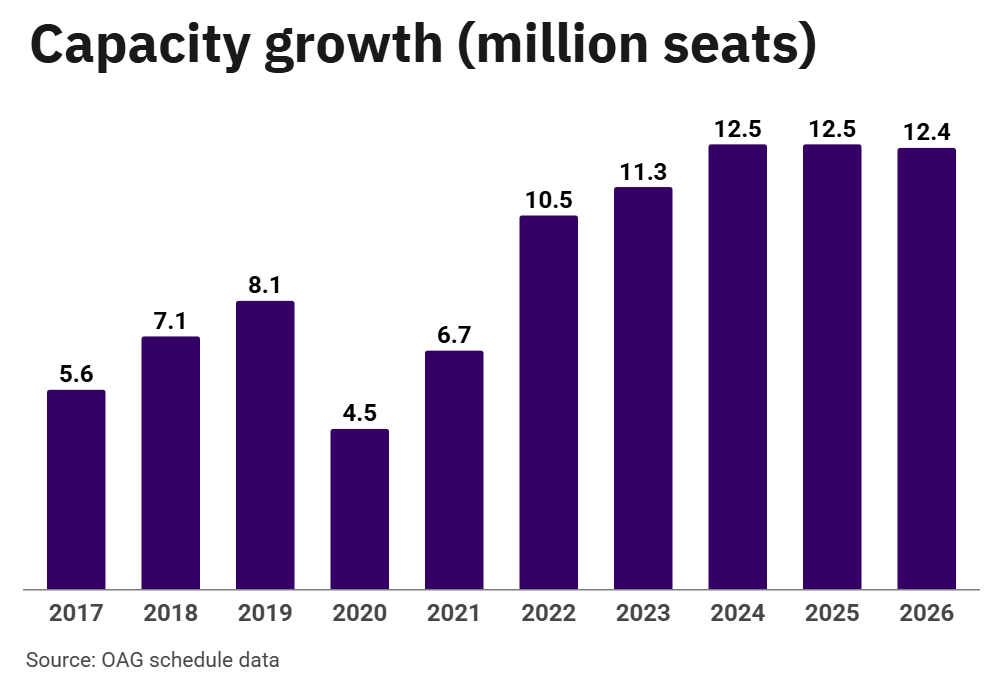
After launching in 2012, Volotea has grown steadily and in 2026 will fly more than double the seats it did in 2017. Like other airlines facing financial challenges this year (airBaltic, Spirit Airlines), it came out of covid as a larger airline than it went in:
After the last B717 retired in January 2021, Volotea’s fleet now consists of 16 x A319 and 26 x A320 for a total of 42 aircraft (according to airfleets.net).
Volotea's niche: small and medium-sized markets
Over the years, the airline has done well to stay largely under the radar of easyJet and Ryanair by focusing on small and medium-sized cities and thinner routes.
Consequently, Volotea is often the only operator on routes it serves. Over half its network is “exclusive” according to its own company information. At two of its top four airports, Asturias, Spain (OVD) and Strasbourg, France (SXB), the airline commands over 50% market share.
Despite being headquartered in Barcelona, France accounts for 44% of seat capacity, followed by Spain with 25%, and Italy with 22%.
At first glance, Volotea’s network appears fragmented. But in reality it is similar to other European LCCs:
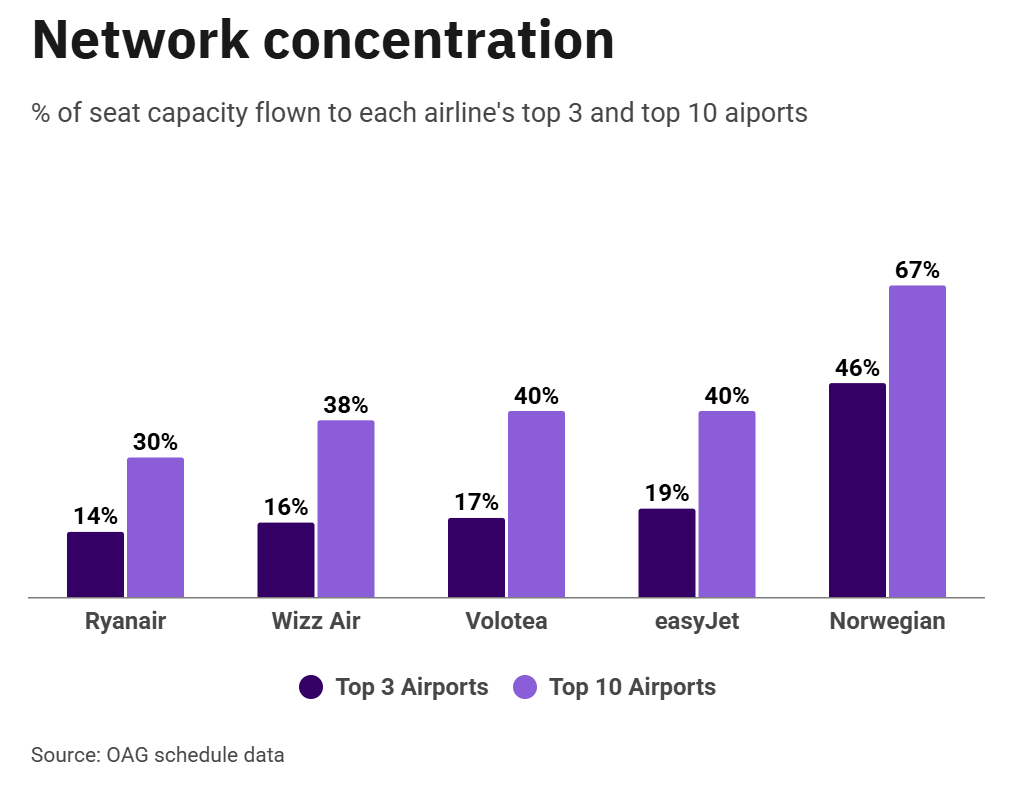
That said, as of July 2026, the airline operated 21 bases. With only 42 aircraft, that means each base averages only two aircraft, which makes it more challenging to deliver economies of scale when it comes to crew productivity or maintenance efficiency.
Volotea’s financial performance prior to the Iran conflict
As a private company, financial disclosure is limited. The airline did, however, publish highlights for 2025:
- €818 million revenue
- €47 million EBIT
- 6% operating margin
- €64 million net loss (due to deferred tax assets and FX translation)
Volotea began to raise new capital in 2024, with strategic partner Aegean Airlines committing an initial €25 million as a convertible loan. The Greek airline subsequently increased its investment and now holds over 20% of equity.
The two airlines operate an extensive codeshare partnership but, at least from the outside, there is not much visible cooperation beyond that.
What does the restructuring process mean?
The airline has proposed to restructure the business with several key focus areas:
- Shrink the fleet from 42 to 30-35 aircraft
- Reduce overhead costs
- Renegotiate terms of its emergency covid loan (€200 million originally due in 2029)
- Raise additional capital
What is the impact on Volotea’s network?
We can already see an impact on the network from capacity cuts. The November schedule will be 30% smaller in terms of seat capacity than last year.
Among Volotea’s top three country markets, France will see year-on-year (YoY) cuts of 39% and Italy 61%. Spain, on the other hand, will grow slightly by 3%.
Certain airports bear the brunt of the cuts, particularly in France and Italy:
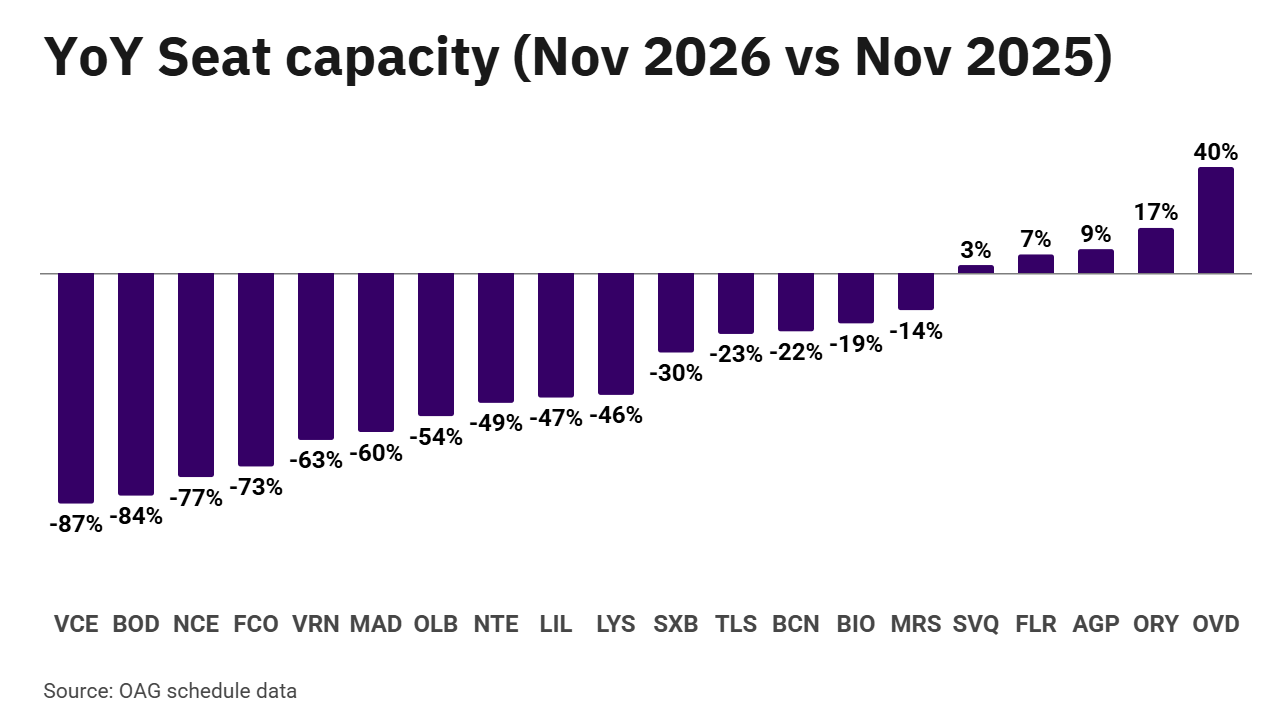
Cutting capacity typically has the biggest impact on yield when an airline’s market share is high. Given Volotea is the only operator on much of its route network, this should work in the airline’s favour.
Meanwhile, 70 routes have been culled compared to November 2025, presumably weeding out under-performing markets from the network. This should also have a positive impact on performance.
The downside is that cuts may create opportunity for the likes of easyJet and Transavia in France, and potentially Ryanair and Wizz Air in Italy.
Where does Volotea go from here?
Volotea has done an impressive job of growing for the past 14 years. It is not easy being a small independent airline in country markets dominated by some of the world’s most formidable LCCs.
However, it is now at a scale which risks over-extension at current fuel prices. Similar to airBaltic, it is probably wise to downsize and retrench to a profitable core.
In the long-term, there is still a question of whether Volotea’s assets maximize their return as an independent entity or rather as part of a larger airline or group. While the A320 family fleet is arguably less suited to Volotea’s traditional thin market niche, it does make the airline a more natural fit for a larger European airline, whether that’s Aegean Airlines or another group.
Photo credit: MarcelX42 via Wikimedia Commons
Data credit: Capacity data supplied by OAG Schedule Analyser


.jpg?ref=enginecowl.com)