


Amid pressure on JetBlue’s turnaround efforts from higher fuel prices and weather-related disruption in Q1, there was at least one bright spot in the airline's quarterly results published on April 28: Fort Lauderdale.
As The Engine Cowl reported previously, JetBlue will become the #1 carrier at Fort Lauderdale Hollywood International Airport (FLL) this year, overtaking Spirit Airlines.
In addition to growing its daily departures, JetBlue is making several key investments at the south Florida airport:
- Moving to a four-bank schedule structure from two banks previously
- Launching 21 new routes over the past year
- Looking for space to add a Blue House lounge
As JetBlue President Marty St. George put it in this week's earnings call, continued investment in FLL will reinforce the focus city’s position as a “third leg” to JetBlue’s stool alongside New York-JFK (JFK) and Boston Logan International Airport (BOS).
Strong Q1 revenue performance in FLL
JetBlue’s investment in FLL seems to be paying off, reporting strong revenue performance for the first quarter at its south Florida focus city.
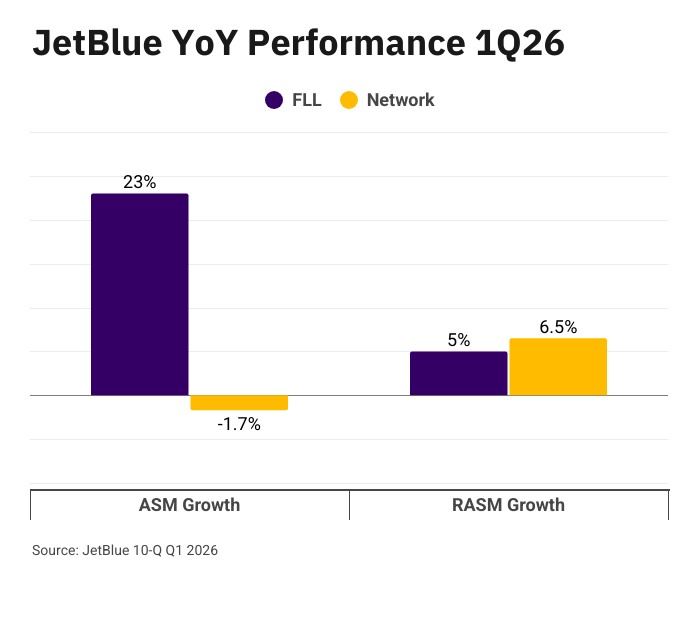
Operating revenue per available seat mile (RASM) was up 5% year-on-year on 23% capacity growth. That is only one point short of its network average RASM growth despite all the new capacity deployed to FLL.
How’s the rest of JetBlue’s business performing?
Unlike the Big Four airlines, profitability at JetBlue weakened in 1Q26 compared to the same quarter last year. Operating margin came in at -10.0% compared to -8.2% last year.
While RASM grew 6.5% YoY, total CASM increased by 8.3% as a result of higher fuel costs and close-in cancellations following weather disruption. The airline expects to be able to recapture 30-40% of extra fuel costs in the form of higher fares in Q2 and recapture 100% of extra fuel costs by next year.
Nevertheless, JetBlue reiterated its aim to turn cashflow-positive by the end of 2027.


