

Ryanair’s June quarter results saw operating profit fall by 37% as operating margin declined from 21% to 13%. While a double-digit operating margin would be a solid outcome for most airlines, this was not Ryanair’s best performance.
Nevertheless, the higher fuel expenses and weaker fares which eroded profitability in Q1 are also likely to reinforce Ryanair’s long-term competitive advantage as its rivals come under pressure through the rest of the year.
Key highlights for Q1
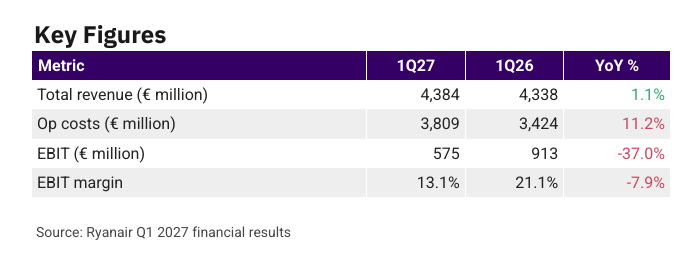
Passenger traffic grew by 6% compared to last year while fares fell by 6% year-on-year (YoY).
Challenging industry outlook for the rest of the year
Bookings for summer 2026 were reported to be strong on volume but following a later-than-usual booking curve. Ryanair’s summer fares are “trending slightly down” in the “low to mid-single digits”. Better close-in yields are not expected to be enough to compensate for discounting earlier in the booking cycle.
Michael O’Leary reiterated that the remainder of the year will be challenging. Higher fuel prices and hesitant consumers are likely to weigh on performance across the sector.
Nevertheless, Ryanair management expects competitors to trim capacity heading into winter if fuel prices remain elevated. Ryanair itself will grow traffic by only 2% in H2 compared to 6% traffic growth in H1.
If correct, this may feed into a stronger yield environment in the medium-term.
Ryanair is 80% hedged at $67bbl for FY27 which puts the airline in a stronger cost position than most others globally.
Restoring gross cash to €4 billion
As has been well-publicized, Ryanair repaid its last remaining bond in May 2026. This is an extraordinary achievement for an airline that owns the majority of its fleet unencumbered.
The only downside is that, as highlighted in our FY26 results commentary, gross cash is now €2.8 billion which is at the low end for an airline of Ryanair’s size.
Michael O’Leary communicated that Ryanair plans to build back to approximately €4 billion gross cash and intends to draw down on the company’s Revolving Credit Facility (RCF) in the coming winter period to support that goal.
Fleet growth in 2027
Looking further ahead, 15 737 Max-10s are expected to join the fleet in spring 2027 (subject to certification).
After a year of constrained fleet growth, this will put Ryanair back into expansion mode and ready to backfill any capacity that may exit the market over what is shaping up to be a tougher winter season.
 Garth Lund