

easyJet reported similar themes to Ryanair for its June quarter results with margin performance coming under pressure from both higher costs and a weaker revenue environment.
Key highlights
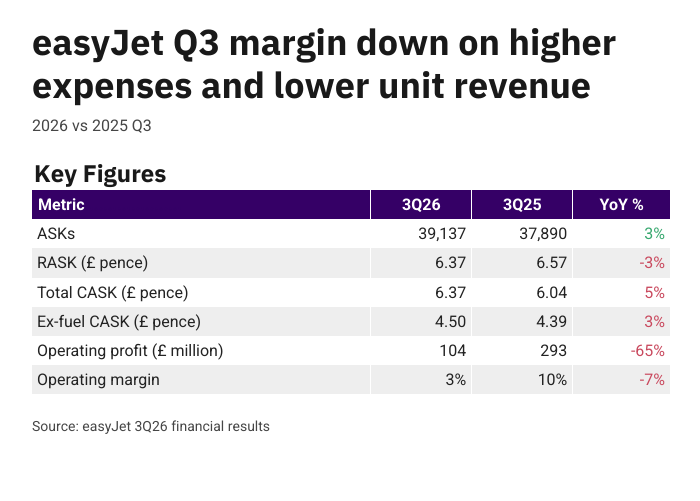
easyJet’s operating margin fell by seven points year-on-year (YoY) from 10% to 3% as a result of both unit cost and unit revenue moving adversely compared to 2025.
Revenue per Available Seat Kilometer (RASK) fell by 3% on the back of 1.3ppt lower load factor and weaker fares.
Cost per Available Seat Kilometer (CASK) rose by 5%, driven by a 3% increase in ex-fuel CASK and a 13% increase in fuel CASK. While easyJet is well-hedged, the unhedged portion of consumption unsurprisingly came in at a higher price, resulting in a £105 million larger fuel bill than last year.
Notably, easyJet Holidays delivered profit before tax (PBT) of £84 million. This accounted for almost all of the Group’s £85 million PBT for the quarter.
Sales outlook
easyJet highlighted that the summer quarter is currently 68% sold, which is 2ppts below last year, at flat yields. The booking curve remains skewed towards departure with strong late bookings.
Early sales for 1Q27 (easyJet’s December quarter) are two points behind last year in terms of load factor but at yields which are up “mid-single digit”.
This should stand easyJet in good stead from a revenue management perspective, particularly if the airline decides to trim any on-sale capacity between now and the start of the winter season.
Capacity maturity
Winter capacity growth is expected to be more moderate than previous years. Over the past three years, easyJet has grown H1 (October – March) utilization by 20%.
The airline will now let this capacity “mature over the coming years” which should help to support revenue recovery in what looks set to be a higher cost environment this winter.
Targeting £1 billion PBT medium-term
easyJet reiterated its commitment to delivering £1 billion PBT in the medium-term and highlighted a number of upcoming "self-help" initiatives to drive revenue growth:
- Launching sales of flight + hotel in the booking flow
- Expanding distribution via 500 bricks and mortar travel agents in Germany
- Launching a loyalty program in 2027
Considering that the airline reported a PBT loss of £552 million for H1 and only £85 million PBT for Q3, there is certainly still some way to go to close the gap to delivering annual profitability of £1 billion.
 Garth Lund