

With all three European network airline groups having reported their Q1 2026 results, The Engine Cowl looks at the key takeaways.
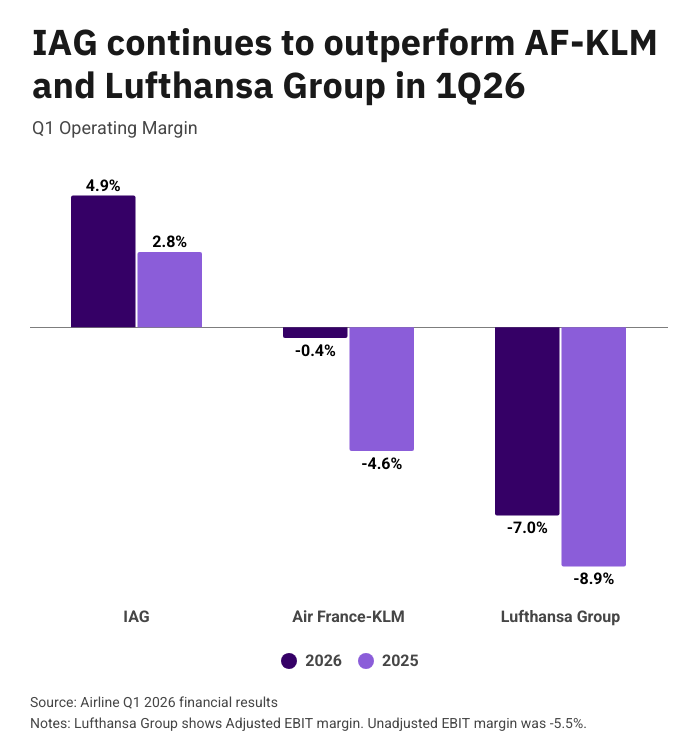
IAG leads performance
IAG continued to outperform Air France-KLM and Lufthansa Group, posting the only positive operating margin of the three businesses.
Nevertheless, all three groups improved margin performance compared to 2025. Air France-KLM closed about a third of the margin gap to IAG.
Higher margins across Europe
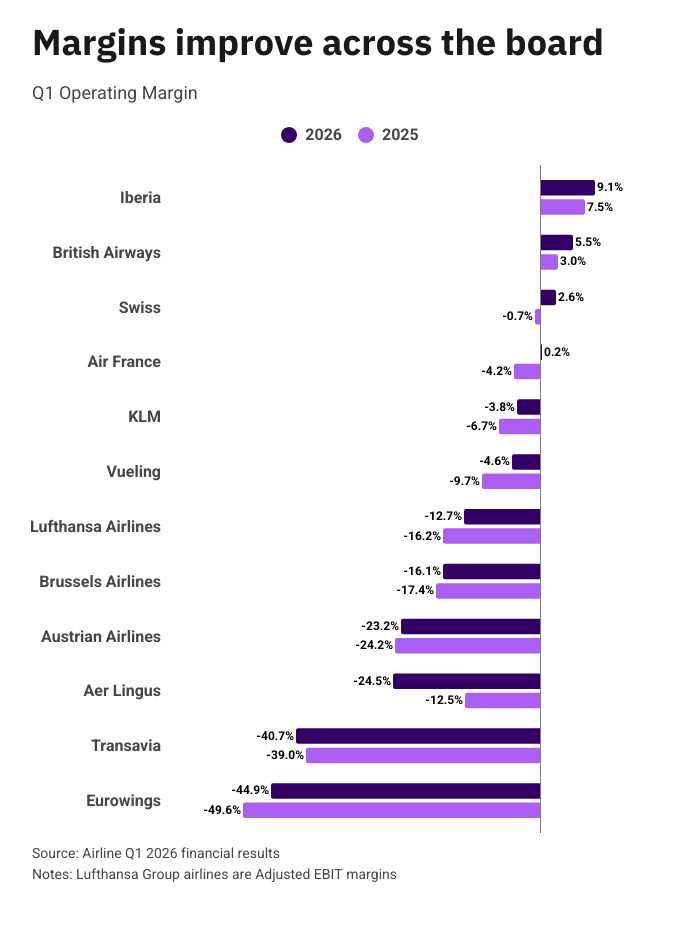
Almost all portfolio airlines within IAG, Air France-KLM and Lufthansa Group delivered higher Q1 margins than in 2025.
Aer Lingus was, however, an outlier with a twelve-point margin reduction compared to last year, citing the impact of “long-haul yield pressure…due to the high levels of competition”. Transavia also saw its operating margin fall by 1.7 points.
Four airlines (Iberia, British Airways, Swiss, and Air France) delivered positive Q1 operating margins. Iberia was the highest margin carrier of the quarter.
The seasonality of the low-cost carrier subsidiaries was clear with both Transavia and Eurowings operating at quarterly margins below -40%. Vueling performed substantially better with a -4.6% operating margin and the largest margin improvement of the bunch. IAG’s domestic passenger revenue per available seat kilometer (PRASK) for Spain and the UK grew by 16.8% compared to last year which is presumably driving stronger revenue performance for Vueling.
Fuel headwinds to come
As expected, all three network airline groups cited higher fuel expenses as a headwind for the remainder of the year.
IAG expects to recapture around 60% of the higher fuel cost through revenue and cost management and will also trim capacity. The group now anticipates to grow capacity by 1% in Q2 and 2% in Q3 while it had previously guided 3% capacity growth for the full-year.
Meanwhile, Air France-KLM expects its fuel bill for 2026 to increase by $2.4 billion compared to 2025 with just under half that increase landing in Q2 based on the jet fuel forward curve. The group will slightly reduce year-on-year (YoY) capacity growth from +3-5% previously guided to +2-4%.
Lufthansa Group emphasized that 80% of its fuel needs for 2026 are "already covered by fuel hedging through derivatives on various oil products" and "still predicts significantly higher Adjusted EBIT than in the previous year". Similar to the other groups, Lufthansa Group has also moderated capacity growth from +4% YoY to +0-2% YoY.
 The Engine Cowl